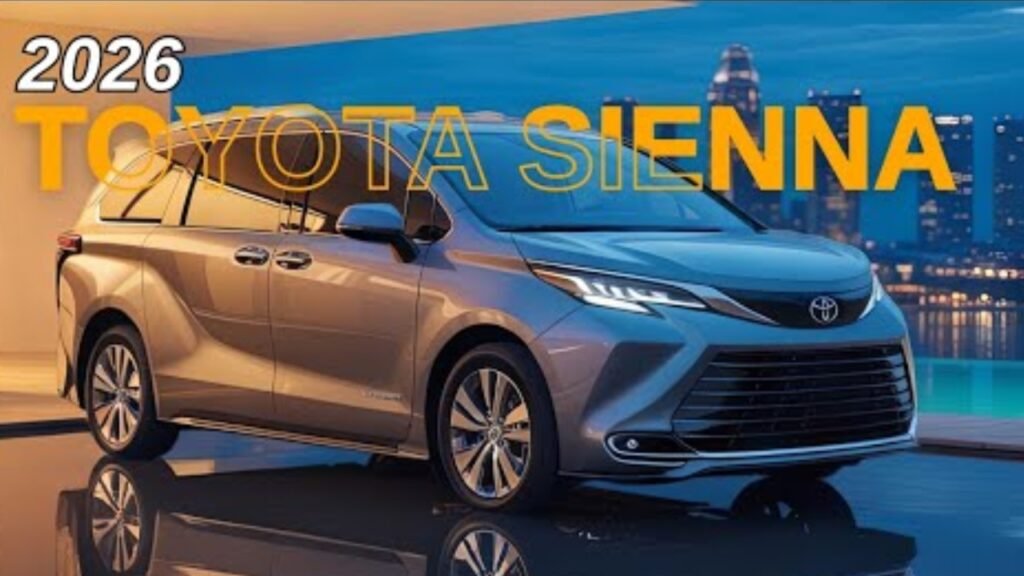
For many, a minivan is primarily about function: carrying people, household gear, sports equipment, groceries. The 2025 Toyota Sienna goes far beyond that. It redefines what family luxury can mean by combining bold design, premium comfort, next‑gen technology, and an official fuel economy that makes it efficient enough to be something you actually enjoy driving every day. Below is a comprehensive look at this model—its strengths, its trade‑offs, and how it stacks up against competition.
1. Toyota Sienna 2025 Features
The first thing you notice about the Toyota Sienna 2025 features is how much more premium it looks than typical minivans. Toyota has restyled the front fascia with sharper LED headlamps, a more sculpted grille, and better integration of trim‑level design elements (e.g., more aggressive lower bumper cladding on higher trims, classy chrome or dark‑accent finishes depending on the trim).
The body itself is long and roomy, with sliding side doors (power or hands‑free on certain trims) and a liftgate that opens high enough to load things easily. In trims like Platinum and Woodland, there are special wheel designs (bigger size, darker finishes), roof rails, and aesthetic touches that give the Sienna a crossover/SUV feel without losing its family van roots.
Color options and exterior accents have also been upgraded: new paint colors, contrast roof‑detail options in some trims, gloss vs matte accents, etc. These are subtle but they make a difference in that “wow” factor when arriving somewhere.
2. Powertrain & Toyota Sienna 2025 Hybrid
One of the defining characteristics of the 2025 Sienna is its hybrid‑only powertrain. There is no purely gasoline‑engine version offered now. The hybrid system combines a 2.5‑litre inline‑4 gasoline engine and electric motors. Combined output is about 245 horsepower with electric assist, which gives enough pep for highway merging, overtaking, and carrying a full family load.
Drive is front‑wheel drive (FWD) on most trims, while all‑wheel drive (AWD) is optional in several trims. The AWD version uses an additional electric motor (or rear motor) to power the rear wheels when necessary. This gives better traction in bad weather or slippery roads, though it comes with slight penalties in fuel economy.
The transmission is a continuously variable transmission (CVT), tuned for smoothness and efficiency rather than sporty shift points. The hybrid system is tuned to balance everyday drivability with fuel conservation.
3. Toyota Sienna 2025 MPG & Range
Fuel economy is a strong point with the 2025 Sienna. For FWD models, the official estimate is 36 mpg combined (city + highway). The 2025 Sienna mpg in city / highway / combined for FWD models is approximately 36 / 36 / 36 mpg. The AWD models drop slightly: in city it may be about 34 mpg, highway about 36 mpg, with combined around 35 mpg.
Given a fuel tank capacity of roughly 18 gallons, the FWD version promises a theoretical driving range of over 650 miles under ideal conditions (light load, moderate speed, favorable driving), which is more than enough for many long road‑trips without frequent stops. The AWD versions will have somewhat lower range due to slightly lower fuel economy.
Of course, actual real‑world mileage depends on many factors: traffic, driving speed, load (how many passengers + cargo), terrain (mountains, hills), use of air conditioning/heating, tire pressure, etc. But even accounting for realistic losses, the 2025 Sienna delivers strong efficiency for its size and capability.
4. Toyota Sienna 2025 Interior Comfort, Technology & Design
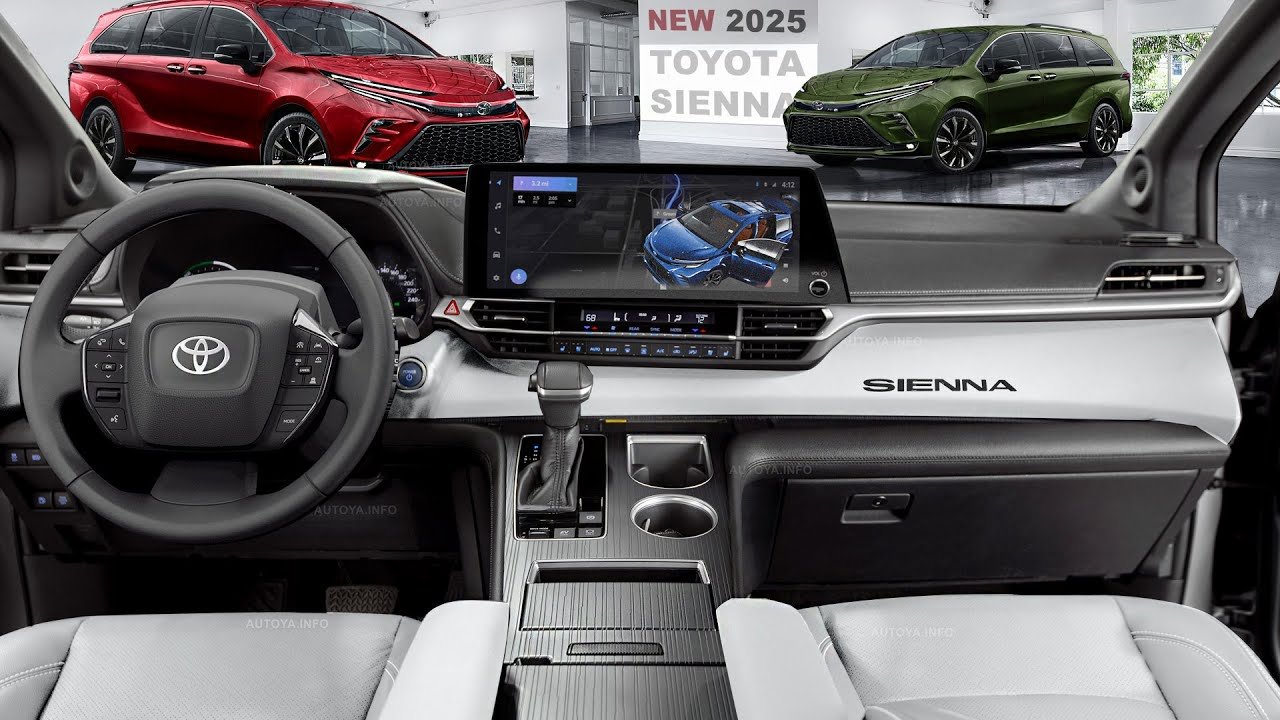
One of the biggest draws of the Toyota Sienna 2025 interior is how family‑friendly and technology rich it is, along with touches of luxury in higher trims.
Seating, Space & Practical Layout
The Sienna is available in 7 or 8‑passenger configurations, depending on the trim. Base trims generally give you 8 seats (three in the second row bench), while higher trims shift to 7 seats by using second‑row captain’s chairs. These captain’s chairs are more comfortable, swing out, slide, sometimes even recline more, which helps with ingress and egress (especially for children or elderly passengers).
Headroom, legroom, shoulder room are generous in the first two rows; third row is more suited for children or smaller adults on long journeys. Cargo space behind the third row is about 33.5 cubic feet, which is enough for several suitcases or a week’s worth of groceries. Folding down the third row gives sizeable space, and with the second row down as well, the maximum cargo volume is over 100 cubic feet, enough to handle large items like furniture or camping gear.
Storage is thoughtful: lots of cup holders (front, middle, rear rows), multiple USB ports for all three rows, available wireless charging pad, cubbies, seat pockets, door pockets. In higher trims, there are features like a “FridgeBox”‑style mini‑cooler in the center console, built‑in vacuum in some trims (very handy for family use: cleaning up food crumbs, etc.), power outlets (110V/1500W capable in certain trims to run small devices), and better ambient lighting.
Infotainment & Connectivity
Toyota has upgraded the multimedia system. Base models come with an 8‑inch touchscreen, wireless Apple CarPlay and Android Auto. Higher trims offer a larger 12.3‑inch touchscreen, better speaker systems (e.g., JBL premium in high trims), multiple USB‑C ports, more advanced gauge clusters (digital displays), sometimes a Head‑Up Display (HUD) in top trim (Platinum).
Rear‑seat entertainment is optional in select trims: screens for rear passengers, wireless headphones, sometimes a remote. Also, convenience tech like the “Advanced Rear‑Seat Reminder” uses motion sensors/radar to sense if a person is still in a rear seat after locking the car—triggers alerts, chimes, hazard flashers, or even phone notifications.
Interior materials are upgraded: SofTex® or leatherette, leather in high trims; improved stitching; ambient lighting; better sound insulation so ride is quieter. The center console layout in higher trims is cleaner and more premium, with more soft‑touch surfaces.
Comfort & Ride Quality
Suspension tuning is better; in some trims there is a sport‑tuned suspension (for example XSE) that gives a slightly firmer ride while trying to maintain comfort. Ride height is fine for most roads; in Woodland Edition, ground clearance is increased modestly for rougher roads. Seats in upper trims are heated, ventilated, sometimes with power adjustment. Climate control is multi‑zone (front, middle, rear in many trims), with rear climate vents, sometimes rear ceiling vents, so that passengers in the back rows are comfortable.
Noise, vibration, and harshness (NVH) management is improved: improved insulation, tighter door seals, acoustic glass in certain trims, etc. All of this makes drives less fatiguing.
5. Toyota Sienna 2025 Safety Measures
Safety is a core part of what families demand, and the Toyota Sienna 2025 safety equipment is strong. It includes both passive and active safety features.
Driver Assistance & Active Safety
Standard features include forward collision warning, automatic emergency braking with pedestrian detection, lane departure warning, lane keeping assist, adaptive cruise control, blind‑spot monitoring, rear cross‑traffic alert.
Some trims add parking sensors (front & rear), surround‑view or panoramic view camera systems (useful for parking in tight spaces or maneuvering), a Panoramic View Monitor in top trims, and parking assist with automatic braking when reversing or maneuvering.
Also included is the advanced rear‑seat reminder or child presence detection system: sensors in second and third row that detect motion; if someone is left inside after locking, the system triggers visual alerts, chimes, and may even send push notifications to connected devices.
Sturdy build quality, multiple airbags (front, side, curtain), strong crashworthiness (from independent testing agencies, where available) also contribute.
Passive Safety & Structural Strength
The structural design uses high‑strength steel in key areas, reinforced pillars, crumple zones. Doors and latches designed for better impact protection. Occupant protection is supported with seat belts (3‑point for all seats), pretensioners, load limiters. Child safety features include up to five LATCH (Lower Anchors & Tethers for Children) locations for car seats spread over the second and third rows.
Safety lighting is also enhanced: LED daytime running lights, LED headlights with auto high beam, improved mirror design for visibility, side mirrors with blindspot alert indicators.
6. Toyota Sienna 2025 Specs: Performance, Dimensions, Towing, and Capacities
Here’s a detailed breakdown of the Toyota Sienna 2025 specs in terms of performance, dimensions, capacities, and more:
-
Engine: 2.5 litre inline‑4 gasoline + electric motors (hybrid system), producing about 245 horsepower and around 176 lb‑ft torque in combined usage.
-
Transmission: Continuously Variable Transmission (CVT) with features to smooth acceleration and improve fuel efficiency.
-
Drivetrain: Front‑wheel drive standard; all‑wheel drive optional in many trims.
-
Fuel Economy / mpg: As noted above, FWD: ~ 36 mpg combined. AWD models sacrifice a bit: roughly 34 mpg city, 36 mpg highway, ~35 mpg combined.
-
Range: With FWD and ~18‑gallon tank, real‑world range often exceeds 600–650 miles (≈ 960–1,050 km) under mixed driving. AWD will have somewhat less.
-
Towing Capacity: Up to 3,500 lbs (approx. 1,588 kg) in properly equipped versions, especially in trims with tow hitch options. Useful for small trailers, boats, or camper gear.
-
Cargo space: Behind the third row, about 33.5 cubic feet. With third row down, second row down, a much larger cargo bay opening. Second‑row space behind first row is large; behind third row is usable in daily life (groceries, gear).
-
Seating capacity: Up to 8 in base 7‑8 passenger trims; usually 7 in higher trims with captain’s chairs.
-
Dimensions (approximate, may vary slightly with trim / wheels / AWD): length around 203‑204 inches; width close to 78.5 inches; height in the ballpark of 68‑69 inches; wheelbase roughly 120‑121 inches.
-
Weight (curb weight): Varies by trims and drivetrain. FWD models weigh less (~ around 4,600‑4,700 lbs), AWD adds extra due to rear motor and drivetrain components.
-
Wheels & tires: Base trims typically come with 17‑ or 18‑inch wheels; higher trims can have 20‑inch wheels. Tires are all‑season; sometimes specific trims have upgraded tires.
-
Warranty: Base models get the standard manufacturer warranty (often about 3 years / 36,000 miles) plus powertrain warranty; hybrid component warranties are typically longer (e.g. 8 years / 100,000 miles) for the battery / motors in many markets.
7. Toyota Sienna 2025 Trim Levels & Price Structure
The Toyota Sienna 2025 trims are arranged to give options from more modestly equipped versions to luxury‑loaded family haulers. Pricing rises with added features, trim bells and whistles, AWD, etc.
Here is an overview of the trims and what they offer, along with prices for U.S. market as reference (excluding taxes, import duties, etc.):
| Trim | Approx Starting Price | Highlights of What You Get |
|---|---|---|
| LE (8‑Passenger, FWD) | Around US$ 39,185 | Basic hybrid powertrain; safety suite; dual power sliding doors; remote keyless entry; blind‑spot monitor; rear cross traffic alert; 7 USB ports; good tech basics; roomy interior. |
| LE AWD | Slightly higher, perhaps ~$2,000 more than LE FWD | Adds all‑wheel drive, which gives better traction; small mpg drop; otherwise similar feature set. |
| XLE | Approx US$ 44,300‑$46,000 depending on seat layout (7 or 8 seats) and FWD/AWD | Upgrades include power tilt/slide moonroof, nicer upholstery (SofTex or premium material), hands‑free sliding doors, more comfort and tech. |
| XSE | Roughly US$ 46,900 for FWD; higher for AWD versions | Sportier styling: different wheels, maybe darker trim, sport‑tuned suspension, upgraded interior touches, larger display screens. |
| Woodland Edition (AWD) | Around US$ 50,400 | More rugged style: higher ground clearance, special wheels, tow hitch, 1500W power outlet, cosmetic upgrades that hint at mild off‑road / outdoor usage. |
| Limited | Around US$ 50,500‑52,500 | Luxury features: leather seating, premium sound system (JBL), more tech (digital cluster, more comfort options), better finishes. |
| Platinum | Top trim, about US$ 56,000+ for highest specs | All top‑tier features: panoramic view monitor, head‑up display, vacuum, fridge box, two‑tone wheels, all creature comforts, premium interior packages. |
These prices are indicative for U.S. market; local markets may have different pricing due to tariffs, taxes, shipping, local content, etc.
8. How Toyota Sienna 2025 vs Rivals
To understand what makes the Sienna shine (or lag), it helps to compare it to its primary competitors in the family minivan / large crossover / 3‑row segment.
Key Rivals
-
Kia Carnival (non‑hybrid)
-
Honda Odyssey
-
Chrysler Pacifica (offerings include Hybrid / Plug‑In Hybrid)
-
Large 3‑row SUVs (e.g. Chevrolet Tahoe / Suburban, Ford Expedition) – though these are much larger / less fuel efficient
Strengths of the Sienna Compared to Rivals
-
Fuel Efficiency: Because the Sienna is hybrid‑only, it has mpg figures that many rivals can’t match in non‑hybrid trims. For families with lots of driving, this is a big savings.
-
AWD Option: Many hybrids don’t offer AWD, especially in the minivan category. Sienna’s availability of AWD is a plus for buyers in regions with snow, slippery roads, or who want better traction.
-
Family‑friendly Safety & Features: The presence of rear‑seat reminders, multiple USB ports, built‑in vacuums / fridge in higher trims, reclinable, slide/captain’s chairs; these practical features give Sienna an edge in usability.
-
Resale and Reliability: Toyota has strong reputation in reliability, and hybrid technology from Toyota is mature. This tends to help retain value.
-
Range and Practicality: Spacious cabin, decent cargo volumes, thoughtful interior layout make it more usable than many crossover SUVs for full‑family loads.
Weaknesses Compared with Rivals
-
Some rivals offer plug‑in hybrid variants or more electric‑only driving range (if that is a priority). Sienna is hybrid, but not plug‑in, so pure EV driving is not an option.
-
For buyers wanting ultra‑luxury interiors (e.g., ultra soft leather, very premium materials, bespoke finishes), high‑end trims of rivals (or luxury brands) may feel more upscale.
-
Price of top trims gets high; value proposition depends on how much you use advanced features. For example, if you don’t need AWD or fridge/vacuum, you may pay extra for features you won’t use much.
-
In some rivals, ride or handling may feel slightly more refined or sporty; Sienna tends to aim for comfort and smoothness, which may mean softer handling in corners.
9. Strengths, Weak Points & Use‑Case Scenarios
To assess whether the 2025 Toyota Sienna is the right vehicle for you, here are the practical strengths and potential tradeoffs, along with scenarios in which it excels or may be less ideal.
What the Sienna Does Very Well
-
If your daily life involves family: kids, pets, groceries, sports gear. The many USB ports, multiple seating options, built‑in vacuum/fridge (in high trims) make cleanup and organizing easier.
-
Long highway drives: because of its mpg and comfort, a Sienna does miles well—your stops for fuel will be fewer, ride fatigue less.
-
Bad weather or slippery roads: AWD versions give you more confidence.
-
Value over time: lower fuel costs + strong resale tend to make hybrid‑Toyota models more affordable over longer ownership periods.
-
Technology features (safety, reminders, connectivity, displays) are quite modern; if you like tech that helps, not just show off, Sienna delivers.
What to Consider / Trade‑Offs
-
If you want pure EV / plug‑in hybrid: Sienna doesn’t offer that. You’ll still be using gasoline.
-
Real‑world mpg will often be lower than the official combined mpg numbers, especially if loaded heavy, driving in stop‑and‑go traffic, using climate control heavily, etc.
-
Higher trims cost a lot; some features may be optional and add cost.
-
If you actually need very off‑road performance (rock crawling, deep snow, serious all‑terrain), the Woodland trim gives more clearance, but Sienna is not an off‑road vehicle.
-
Width, turning radius, parking in tight spaces may be more challenging than with smaller SUVs.
10. Detailed Figures & Real‑World Usability
To give you a more grounded sense, here are more detailed specs and some real owner experiences with Toyota Sienna 2025 specs and performance.
-
Real cargo behind third row: ~ 33.5 cu.ft.
-
Behind second row: much more (75+ cu.ft.).
-
Max cargo (seat fold) beyond 100 cu.ft.
-
Towing: 3,500 lbs is useful; you could tow small boats, trailers. Not huge towing like large SUVs or trucks, but in line with many minivans.
-
MPG: Owners report FWD versions achieving near or a bit below the official numbers (somewhere in low 30s city when traffic heavy, better on highway). AWD versions lose ~1‑2 mpg in city vs FWD.
-
Driving feel: Acceleration is decent—not sports car, but enough for merging. CVT tends to smooth out accelerations rather than sharp shifts. Suspension tuned for comfort; corners will have some body roll, but cleanliness of ride is good.
-
Interior noise: quieter at highway speeds than many older minivans; wind noise around mirrors, road noise through tires in some wheel/tire combos still noticeable, but overall good.
-
Convenience: Sliding doors are a big plus (power/hands‑free versions even more). The rear‑seat reminder is more than just marketing: many parents like the radar motion detection systems that warn if someone is inadvertently left behind.
11. Toyota Sienna 2025 Price & Value Over Time
Toyota Sienna 2025 price starts at roughly US$39,185 for the base LE FWD model. As you move up in trim (XLE, XSE, Woodland, Limited, Platinum), add AWD, or add luxury/convenience packages, price can climb to over US$56,000 for top‑trim fully loaded Platinum AWD.
To gauge value: initial cost is higher for the hybrid system and premium features, but fuel savings, lower maintenance (hybrids tend to have fewer mechanical wear items in certain respects), and resale value tend to offset some of that cost over years of use.
Additionally, in many markets, there may be tax incentives, rebates, or lower registration taxes for hybrid vehicles, which can improve total cost of ownership. Insurance costs may be slightly higher in higher trims because of more features, more expensive parts, etc.
12. Toyota Sienna 2025 vs Rivals in Deeper Comparison
Here are side‑by‑side comparisons along specific axes:
| Comparison Axis | How Sienna 2025 Performs | Rivals Strengths / Where They Might Outperform |
|---|---|---|
| Fuel Economy | Excellent; 36 mpg combined (FWD); strong for AWD; among top in hybrid minivans. | Rival hybrid or plug‑in models may beat Sienna in city or electric‑only segments (if PHEV). Some non‑hybrids may have worse fuel economy but cost less upfront. |
| Interior Comfort & Usability | Very good: 7‑8 seats, great space, lots of convenience features; rear‑seat reminder; fridge/vac in high trims. | Some rivals have more premium upholstery, more options for entertainment or ultraluxury trim finishes; some may offer more custom seating configurations. |
| Safety Tech | Strong package; standard driver assistance; motion sensors in rear; many passive safety features. | Some rivals may have more advanced ADAS (driver‑assist) suites, perhaps newer versions of safety packages; some focused on luxury may include higher end camera systems, lidar/radar integration, etc. |
| Cost | Higher up front for higher trims; base models are reasonable for what you get. Fuel savings help. | Rivals might offer lower base prices; options‑pricing may vary; some features standard on rivals could be optional on Sienna in some trims. |
| Resale, Reliability | Toyota has strong brand reputation; hybrid systems are well proven. | Some rivals may offer longer warranties or special maintenance packages; others may not hold value as well. |
13. Who Should Buy the 2025 Toyota Sienna
To make this more practical, here are some buyer profiles:
-
Large families who do long highway trips, need space for gear plus people, want efficiency, and comfort.
-
People in regions with mixed weather (rain, snow) who would appreciate AWD.
-
Drivers who care about fuel costs and want lower operating cost in the long run.
-
Families with children (young kids), needing LATCH anchors, lots of USB ports, reminders, sliding doors, easy cleanup etc.
-
Vehicle for road trips or weekend getaways: cargo room, range, comfort, features like fridge / vacuum, power outlets make it ideal.
It might be less ideal for someone who:
-
Wants a pure EV or PHEV with substantial electric‑only range.
-
Needs extremely compact vehicle for tight city parking.
-
Wants super sporty handling or performance above what a hybrid minivan can deliver.
14. Summary & Final Thoughts
Putting it all together:
The 2025 Toyota Sienna delivers on nearly every front families tend to care about. It’s not just bigger; it’s smarter. From its Toyota Sienna 2025 features like built‑in refrigerator box and in‑console vacuum, to its hybrid powertrain, generous space, safety technologies, and high fuel efficiency (Toyota Sienna 2025 mpg ~ 36 combined in ideal FWD cases), it steps up the expectation in the segment.
Its specs—245 hp, 7‑8 passenger seating, ~3,500 lb towing, large cargo volumes—make it capable without being extravagantly over the top. The interior feels modern, comfortable, and well‑thought‑out, especially in higher trims. Safety is not an afterthought: the reminder systems, blind‑spot monitoring, advanced sensors are meaningful.
In terms of value, though the price of top‑trims can become high, many of the key features are available lower down, so you can pick a version that suits your budget. Over time, savings in fuel, lower maintenance, strong resale will tend to reward those who choose wisely.
Compared to rivals, Sienna’s hybrid advantage and practicality stand out. If you’re weighing choices, the Sienna often wins if your priorities include family comfort, safety, and fuel efficiency more than raw luxury or sporty dynamism.