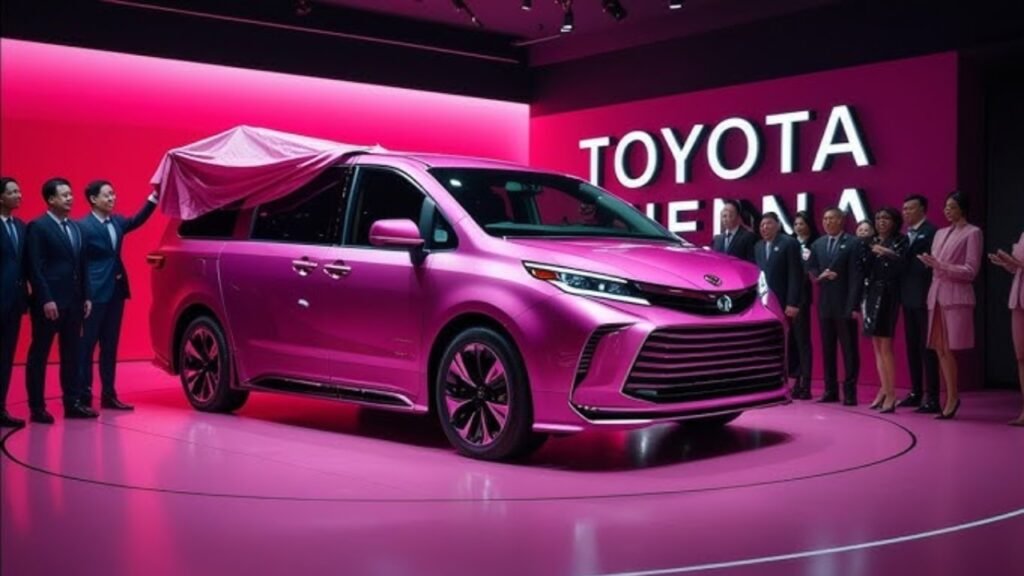
In a time when auto manufacturers are striving to balance performance, sustainability, and everyday utility, Toyota has pushed the boundaries with the Toyota Sienna 2025 hybrid. This model aims to combine the rugged capability of an SUV, the luxurious comfort of a sedan, and an efficiency that raises the benchmark for family haulers. Whether you’re considering the Toyota Sienna 2025 AWD for added traction or the base FWD for maximum economy, this vehicle presents a compelling package. In this article, I explore in depth its features, interior, mpg, price, release date, reviews, safety features, specs, and more—presented with a human tone and attention to facts.
Introduction & Positioning
Toyota presents the 2025 Toyota Sienna with the declaration that it delivers the “power of an SUV, comfort of a sedan, and efficiency that sets new standards.” This is not simply marketing fluff. The 2025 Sienna is a meaningful advancement in Toyota’s hybrid platform for minivans—offering improvements in drivetrain, interior refinement, tech, and customer‑oriented conveniences.
Toyota has built a reputation on durability, resale value, and usable interior space. What the 2025 model seeks to do is maintain those strengths while tackling pain points: reducing fuel use, enhancing ride quietness, modernizing interfaces, offering an AWD variant, and refining the design. For those needing a three‑row vehicle for daily driving, family trips, or varied terrain, the Toyota Sienna 2025 may represent a new benchmark.
Release Date & Market Timing
When will you be able to get your hands on one?
-
Toyota tends to introduce new model‐year vehicles in the late summer or early fall. The 2025 Sienna is expected to hit showrooms in the U.S. between August and October 2024.
-
Initial announcements of the 2025 Sienna occurred around September 2024, with official specifications released thereafter.
-
Delivery timing may be phased: flagship or premium trims often arrive first, followed by mid‑ and entry‑level versions.
-
Some dealers and customers are already reporting long waiting lists—sometimes up to a few years—due to high demand, constrained supply, or production bottlenecks.
Thus, even though the “release date” is known in general terms, the real challenge for many buyers is waiting for availability and confirming when their ordered trim will arrive.
Exterior Design & Styling
While the silhouette remains recognizably Sienna, the 2025 model introduces several styling refinements that elevate its presence.
Front End & Lighting
The front fascia features a more aggressive grille with sharper lines and a bold lower apron. LED headlights are slim and well integrated, with higher trim levels offering adaptive lighting or more advanced LED arrays. There are subtle vents and design accents that evoke crossover styling without sacrificing minivan practicality.
Side Profile & Doors
The sliding door tracks are more seamlessly blended into the body, giving a cleaner side appearance. Sculpted body creases and character lines help visually break up the large surface areas. Wheel size choices vary by trim—higher trims often have larger, more stylized alloy wheels. Roof rails are available on variants aimed at more utility or outdoor gear carrying.
Rear Styling
At the back, wraparound LED tail lamps are present, sometimes connected by a thin light strip in premium trims. The rear liftgate (tailgate) may be power‑operated on higher trims, while simpler trims use manual operation. A subtle roof spoiler helps with airflow and adds some visual sportiness.
Color options & Trim Accents
Toyota offers a broad palette of exterior colors. Certain colors and styling accents (gloss‑black trims, chrome strips, special wheels) are reserved for premium or special edition trims. Overall, the style upgrades help the Sienna feel more upscale than earlier iterations, narrowing the gap between minivan and crossover aesthetics.
Powertrain & Drivetrain Options
At the heart of what makes the Sienna 2025 special is its fully hybrid design.
Hybrid‑Only Lineup
-
The 2025 Toyota Sienna is offered exclusively as a hybrid—no pure gasoline V6 variant.
-
The hybrid system pairs a 2.5‑liter inline‑4 gasoline engine with one or more electric motors, delivering a combined output of about 245 horsepower.
-
Torque is in the neighborhood of 176 lb‑ft.
-
The transmission is an e‑CVT setup (similar to Toyota’s established hybrid systems), tuned for smoothness and efficiency rather than sport performance.
FWD vs AWD
-
The base configuration is front‑wheel drive (FWD), which gives the best fuel economy.
-
For those who need better traction—snow, wet roads, uneven surfaces—there is an AWD option. The AWD version uses an additional electric motor at the rear axle to drive the back wheels when needed.
-
Because the extra motor is electric and only engages when required, the drop in fuel efficiency (comparing AWD to FWD) is modest, not drastic.
Drive Behavior & Hybrid Operation
-
At city speeds, low-load driving, and stop‑and‑go traffic, the Sienna often operates in electric‑assist or electric‑dominant mode, helping reduce fuel consumption and lowering noise.
-
When higher power is needed (accelerating onto highways, carrying full load, passing other vehicles), the gasoline engine comes in more aggressively—and its sound becomes more noticeable.
-
The hybrid logic is tuned to balance energy recuperation (regenerative braking), smooth transitions, and minimizing fuel usage.
In short, the drivetrain options reflect a thoughtful compromise: you get strong efficiency from FWD, the assurance of AWD when conditions demand it, and the reliability of Toyota’s hybrid experience.
Performance, Acceleration & Driving Feel
Even though it’s a minivan, performance matters—for merging, overtaking, highway driving, and even hills.
Acceleration & Power Delivery
-
The FWD version of the 2025 Sienna is reported to achieve 0–60 mph in about 7.6 seconds. The AWD version may be slightly slower due to added weight.
-
In everyday driving—city, suburbs—the power delivery feels sufficient. Electric assist helps with low‑end torque, easing initial acceleration from standstill.
-
On highways, passing maneuvers demand more from the gasoline engine; under full throttle, engine noise becomes more prominent.
Ride Comfort & Handling
-
Suspension tuning is oriented toward smooth ride over comfort rather than sharp sporty handling. It absorbs road imperfections well, making long drives more pleasant.
-
Steering feel is adequate for its class. It is not highly responsive or sporty; some drivers report a bit of vagueness in tight cornering or parking maneuvers.
-
Braking systems are well‑tuned, leveraging regenerative braking along with traditional brakes for smooth deceleration.
-
In AWD models, grip is improved under slippery or uneven road conditions. But this is not a vehicle intended for heavy off‑road duty; it is more about safe all‑weather handling.
Overall, driving feel favors comfort and reliability. It’s not built for performance thrills, but for confidence, smoothness, and usable power.
Fuel Economy & Efficiency (mpg)
This is arguably one of the strongest selling points of the 2025 Sienna.
Ratings & Real‑World Performance
-
Front‑wheel drive models are rated around 36 mpg city / 36 mpg highway / 36 mpg combined.
-
All‑wheel drive models predict slightly lower efficiency—e.g. 34 mpg city / 36 mpg highway / about 35 mpg combined.
-
In mixed driving, many owners suggest real‑world numbers come fairly close to those estimates when driving conservatively.
Variables That Affect Efficiency
-
Heavy load, full passenger complement, or carrying lots of cargo will reduce mpg.
-
Driving at high speeds, rapidly accelerating, or towing (if towing is permitted) will also lower efficiency.
-
Cold weather, frequent stop/start traffic, and use of climate control (especially heating) may reduce electric assist time and so reduce economy.
-
The AWD model sees a mild drop in mpg due to added weight and drivetrain complexity, but it remains efficient relative to non‑hybrid, non‑AWD minivans.
In short, the Toyota Sienna 2025 mpg ratings are among the best in its class for a three‑row family vehicle, especially once you account for its hybrid layout and the inclusion of AWD in some trims.
Interior, Comfort & Practicality
Family life demands more than horsepower. How does the cabin and practicality stack up in the 2025 model?
Seating, Space & Passenger Comfort
-
The Sienna is available with either 7 or 8 passenger seating layouts. The 7‑seat option uses second‑row captain’s chairs; the 8‑seat uses a second‑row bench.
-
Front row offers generous legroom, headroom, and a well‑cushioned seat for long journeys.
-
Second row in captain’s chair form is more premium, offering comfort, individual armrests, and good spacing.
-
Third‑row is better suited for children or shorter rides when full occupancy is involved; for adults, space is reasonable but limited.
Materials, Finish & Upgrades
-
Toyota has upgraded upholstery, trim materials, and stitching in the 2025 iterations. There’s better softness, more premium feel in touch surfaces.
-
High trims include leather or high‑grade synthetic leather, contrast stitching, accent trims (wood, metallic or color inserts).
-
Ambient interior lighting, decorative trims, and better sound deadening materials are more prevalent in higher trims.
-
More USB ports (USB‑C and USB‑A), wireless charging pads, improved ventilation for rear rows—these all add to convenience.
Cargo & Utility
-
The second row is fixed (non‑removable or non‑fold‑flat in many versions), reducing maximum flexibility in cargo space.
-
With all rows occupied, the cargo space behind the third row is adequate for daily errands, groceries, small luggage.
-
For larger loads (e.g. major moving, bulky gear), other vehicles with stowable or removable seats may perform better.
-
Roof rails on certain trims enable external cargo or gear carrying. Many trims also provide plenty of storage bins, cup holders, overhead compartments, door pockets.
Ride, Noise, Comfort Factors
-
Under normal driving, cabin is quiet; the hybrid system helps suppress low‑speed engine noises. Road and wind noise are reasonably well managed.
-
Under heavy acceleration or high engine load (e.g. climbing hills or passing), the noise floor increases, and the engine becomes more audible.
-
Climate control works well; multi‑zone systems ensure rear passengers are not neglected. Rear vents are present; optional features like sunshades improve comfort on sunny days.
All told, the Toyota Sienna 2025 interior blends comfort and utility well. There are trade‑offs, especially with regard to cargo flexibility, but for most daily needs, it should satisfy very well.
Technology & Features
Modern vehicles must deliver in tech and convenience. The Sienna 2025 brings a lot in this domain.
Infotainment, Displays & Connectivity
-
The base (LE) trim uses an 8‑inch touchscreen. In trims above that, a 12.3‑inch infotainment screen is standard.
-
Higher trims also include a 12.3‑inch digital gauge cluster, which pairs visually with the main screen for a sleek driver‑angle layout.
-
Functionality includes wireless Apple CarPlay, Android Auto, multiple USB‑C and USB‑A ports, Bluetooth, and options for navigation.
-
Premium audio systems are included in upper trims. Wireless charging pad(s) may be offered.
Convenience & Comfort Features
-
Keyless entry and push‑button start are standard on most non‑base trims.
-
Power sliding doors in many trims; power tailgate on higher specs.
-
Rear seat sunshades or window shades to reduce glare and improve privacy.
-
Rear occupant detection systems (to detect people or pets left behind) are included in some trims for added safety.
-
Built‑in vacuum cleaner or fridge box are available in premium versions, catering to long trips or high‑comfort users.
Software, Driver Aids & Updates
-
Vehicle systems may support over‑the‑air updates for software, enabling improvements in infotainment or adaptive systems over time.
-
Multi‑information displays provide real‑time feedback on fuel usage, hybrid system behavior, warnings, and trip info.
-
Many trims include advanced driver assistance: adaptive cruise control, lane keeping, road sign recognition, automatic high beams, etc.
These Toyota Sienna 2025 features make it more than just a people‑mover; in its top trims, it starts feeling like a luxury‑tinted utility vehicle with all the modern conveniences.
Safety & Driver‑Assist Systems
Safety is non‑negotiable in this class, and the 2025 Sienna delivers solidly in both active and passive safety.
Active Safety & Driver Assistance
-
The 2025 Sienna includes Toyota Safety Sense 2.0 across all trims (the company’s established suite of driver assist features).
-
Standard features include a pre‑collision system (with pedestrian detection), lane departure alert with steering assist, lane tracing assist, full‑speed dynamic radar cruise control, automatic high beams, and road sign assist.
-
In higher trims, additional features may include blind spot monitoring, rear cross‑traffic alert, a 360‑degree camera system, and parking sensors front and rear.
Passive Safety & Crash Protection
-
Reinforced body structure with crumple zones and high‑strength steel structural members help in crash absorption.
-
Multiple airbags: front, side, and full‑length curtain airbags for all three rows.
-
Child‑seat anchors (ISOFIX or equivalent), strong seat belts, tether points, ensures child‑safety compliance.
-
Rear occupant detection, so that if someone is left in the vehicle after doors are closed, alerts are given (newer for 2025).
Recalls & Safety Notices
-
As with many new models, some issues have surfaced, such as concerns over weak welds in second‑row seat rails in certain production batches. This has led to voluntary recalls to ensure the safety and durability of those components.
-
Toyota has committed to remedying such issues free of cost when controller or authorized service providers confirm the affected VINs.
Safety wise, the Toyota Sienna 2025 safety features are strong and generally meet or exceed expectations for its class—though, as with all new models, some initial problems are being addressed.
Pricing, Trims & Global Availability
Important for buyers: what does it cost, what trims are available, and where can you buy it.
Pricing & Trim Levels (U.S. & North America)
-
The base LE trim (FWD) starts in the vicinity of $39,000‑$40,000 (depending on options).
-
Upgrading to AWD adds cost (often about $2,000 extra in U.S. markets).
-
Higher trims (XLE, XSE, Limited, Platinum, Woodland Edition) have progressively more features and thus progressively higher MSRPs. The upper trims may include premium amenities such as leather seats, premium audio, more driver aids, power tailgate, etc.
Trim Hierarchy & Key Differences
Here’s a typical rundown of what each trim adds:
| Trim | Additional Features Compared to Lower Trim |
|---|---|
| LE (Base) | Hybrid drivetrain, essential safety features, basic upholstery and screen size |
| XLE | Adds upgraded infotainment, better interior materials, power sliding doors, more comfort features |
| XSE | Sportier styling details, unique wheels, possibly enhanced trim accents |
| Limited | Premium materials, enhanced sound system, more convenience features |
| Platinum | Top‑tier luxury touches, full range of comfort and tech upgrades, highest luxury interior feel |
| Woodland Edition | Special styling, exclusive colors, possibly unique wheels, design tweaks to stand out |
Global Availability & Local Pricing (e.g. India)
-
In markets outside North America, pricing is significantly affected by import duties, regulatory compliance costs, logistics, and taxes. What starts at about USD 40,000 in the U.S. can cost much more elsewhere.
-
In India, for example, estimates for higher‑trim versions run into multiple millions of rupees because of import duty plus local costs. Availability may be limited to certain trims or specifications.
Real‑World Cost of Ownership
-
Hybrid systems tend to lower fuel and maintenance costs over time compared to pure gasoline large engines.
-
Insurance, tax, parts, and servicing may be more expensive for top‑trim or AWD models.
-
Depreciation is likely moderated by Toyota’s strong resale value reputation.
Overall, while the Toyota Sienna 2025 price is high compared to some non-hybrid minivans, the combination of features, efficiency, and brand value gives strong justification for the investment.
Competitors & Market Context
To understand how special the 2025 Sienna is, we need to see what else is available.
Main Rivals
-
Honda Odyssey stands as a traditional minivan staple: strong cargo flexibility, seat configurations, reliability—but lacks hybrid propulsion.
-
Chrysler Pacifica / Pacifica PHEV offers a plug‑in hybrid version that gives short electric‑only driving, but often at higher purchase price and possibly lower long term fuel savings if plug‑in capability is under‑utilized.
-
Kia Carnival is a newer competitor; its hybrid variant brings performance and styling challenges, though its cargo flexibility and cabin layout often contrast with what Sienna offers.
-
In some markets, large three‑row SUVs with hybrid or plug‑in hybrid technologies also compete in terms of image and utility, though often with worse fuel economy or higher ownership costs.
Strengths & Weaknesses Compared to Rivals
Strengths:
-
Efficiency from hybrid powertrain (especially strong in the FWD version).
-
AWD option is rare in its class (minivans), giving an edge in weather or low‑traction conditions.
-
Toyota’s reputation for reliability, strong resale value, and wide service/parts network.
-
Interior features are generous, especially in higher trims; comfort is a strong focus.
Weaknesses:
-
Seat configuration is less flexible than some rivals—fixed second row reduces maximum cargo versatility.
-
Engine and drivetrain noise under certain conditions less refined than in some competitors.
-
Safety suite is good but not necessarily class‑leading in terms of driver assistance features in all trims.
-
High initial cost and possibly long wait times for delivery.
Trends & Where the Market Is Headed
-
Demand for hybrids and plug‑in hybrids continues rising. Consumers are increasingly conscious of fuel costs and environmental impact.
-
Automakers are under pressure to reduce emissions, so hybrid setups that can deliver usability with lower emissions are appealing.
-
There’s speculation among enthusiasts and analysts that Toyota could introduce a plug‑in hybrid or full electric version of the Sienna in the future, especially as regulations tighten.
-
The balance of comfort, tech, safety, and driving ease is becoming more critical in family vehicles; simply having space is no longer enough.
Pros, Cons & Real‑World Owner Feedback
What are users saying? What does the Sienna do well—and where do people wish it were better?
Pros
-
Excellent fuel efficiency for its class. Many owners report fuel use close to published numbers under moderate driving.
-
AWD availability adds safety and peace of mind without a severe mpg penalty.
-
Comfortable ride, especially on longer trips; good cabin insulation for normal cruising.
-
Strong interior feature set—USB ports, smart storage, rear comfort, optional extras like built‑in vacuum or fridge box are appreciated.
-
Modernized infotainment and displays help the Sienna feel up‑to‑date compared to older minivan models.
Cons
-
Limited cargo flexibility due to fixed second‑row seating in many trims; inability to fold or remove seats as some rivals do.
-
Noise under heavy throttle or on steeper grades—engine becomes more noticeable, less isolation compared to luxury SUVs.
-
Steering feel is safe and stable but not engaging; some report lag or vagueness in tight maneuvers.
-
Safety tech is robust but uses an earlier version of Toyota’s driver assist system; in some aspects, rivals are ahead.
-
Cost & wait times—high purchase price for top trims; delays in availability depending on region.
-
Recall issues such as seat rail weld problems have raised some concern among owners.
What Owners Typically Notice
-
In cold weather or with many passengers, fuel economy is lower than ideal—but still better than older, non‑hybrid competitors.
-
AWD helps noticeably in rain or snow; drivers in northern or wet climates report better confidence with AWD.
-
The interior comfort is a big plus—lower fatigue, more usable cabin storage, better materials compared to previous versions.
-
Smaller irritants: plastic feel in some trim edges; liftgate and sliding door mechanisms feel lighter in lower trims; engine sound under load.
Outlook, Future Prospects & Conclusion
What’s Next for the Sienna Family
-
The current generation may continue until the 2026 model year before a full redesign, possibly set for 2027.
-
A plug‑in hybrid (PHEV) or full electric version is widely speculated; such variants would help Toyota meet stricter emissions and fuel economy regulations.
-
Possible upgrades in future years include more advanced driver‑assist systems (e.g. Toyota Safety Sense 3.0 or beyond), refined cabin noise suppression, and perhaps more flexible interior seating systems if customer demand drives development.
Final Evaluation
Does the 2025 Sienna live up to being the “ultimate hybrid marvel”? To a large degree, yes. It succeeds in combining:
-
Power, enough for day‑to‑day driving, overtaking, and reasonable highway performance;
-
Comfort, with a refined ride, improved materials and tech, interior amenities that cater to families;
-
Efficiency, with impressive mpg figures for its size, especially FWD models, and a modest drop when opting for AWD;
There are trade‑offs: less cargo flexibility, engine sound under demand, and delivery delays in many markets. For buyers who prioritize fuel savings, comfort, reliability, and versatile family usage over maximum cargo or sporty driving, the 2025 Sienna is among the very best choices in its class.
If I were advising someone considering it: check your local trim prices and what features are standard in your region; test drive both FWD and AWD if possible; and consider how often you’ll need maximum passenger load or extra cargo space. With those in mind, the Sienna 2025 could very well set a new standard for what people expect from a hybrid family vehicle.