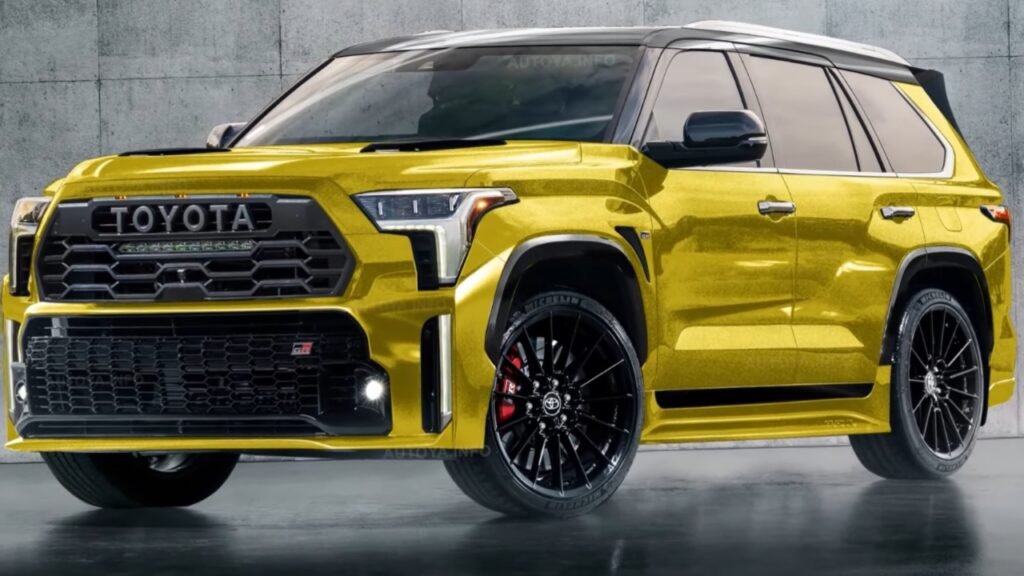
When you hear “Toyota Sequoia,” you probably think of a mammoth, capable, full-size SUV built for families, adventures, and towing heavy loads. The 2025 Toyota Sequoia doesn’t simply rest on its reputation — it reinvents it. With bold styling, hybrid efficiency, and jaw-dropping power, this latest Sequoia aims to rewrite the rules for what a full-size SUV can be. In this article, we’ll dive deep into what makes the 2025 Sequoia truly transformative — from Toyota Sequoia price, Toyota Sequoia specifications, Toyota Sequoia trim levels, Toyota Sequoia MPG, Toyota Sequoia towing capacity, Toyota Sequoia release date, Toyota Sequoia interior features, Toyota Sequoia hybrid, Toyota Sequoia vs competition, to Toyota Sequoia reviews — giving you a full 360° view.
1. Introduction: The Bold New Sequoia
Toyota has long held the Sequoia as its flagship full-size SUV — a vehicle that evokes ruggedness, space, and capability. Yet in recent years, buyers have also demanded better fuel economy, smarter tech, and more refined road manners. The 2025 Toyota Sequoia is Toyota’s bold answer: a hybrid-powered behemoth that doesn’t compromise on either muscle or efficiency.
This iteration intends to shock the SUV world — not just with size and presence, but with a powertrain and feature set you’d expect in the next generation. It’s part evolution, part revolution. As you read on, notice how the 2025 Sequoia addresses age-old tradeoffs and stakes its claim in a fiercely competitive full-size SUV market.
2. What’s Changed in 2025
Before diving into specs, trim by trim, here’s a snapshot of what’s new or refreshed in the 2025 Toyota Sequoia:
-
The hybrid i-FORCE MAX twin-turbo V6 powertrain becomes standard across the lineup, marking a complete shift away from older gasoline-only setups.
-
Massaging front seats now come standard on the higher trims (Platinum and Capstone), enhancing the luxury quotient.
-
Optional towing mirrors are now available on the Capstone version, adding practicality to premium styling.
-
A new TRD Pro–exclusive color “Mudbath” debuts, giving that off-road trim extra flair.
-
Toyota has also introduced a 1794 Edition, further expanding the palette of trim options.
These changes are not mere tweaks — they signal Toyota’s clear intention to position the 2025 Sequoia as a hybrid powerhouse, not just a traditional full-size SUV offering.
3. Price & Positioning
One of your key keywords is Toyota Sequoia price, and here’s how the 2025 model is positioned:
-
The base SR5 trim starts at about US $62,425 (MSRP) for the non-4WD version.
-
For 4WD versions or higher trims, price escalates accordingly. For instance, the Limited 4WD begins around $71,825 in some configurations.
-
The Platinum trim commands around $79,570 as a base 4WD model.
-
The ultra-premium Capstone trim commands a top MSRP of around $83,915.
-
In between, trims like TRD Pro register an MSRP near $80,295.
-
Toyota also indicates some variations depending on features like 4WD, optional equipment, regional pricing, etc.
From a positioning standpoint, the 2025 Sequoia is not meant to be an entry-level SUV — it competes squarely with high-end full-size SUVs that deliver both performance and comfort.
4. Powertrain & Hybrid System
Perhaps the most dramatic shift in the 2025 Sequoia is its move to a full hybrid powertrain. Let’s break it down.
i-FORCE MAX Hybrid System
-
The Sequoia uses the i‑FORCE MAX Twin-Turbo V6 Hybrid, which pairs a 3.4-liter twin-turbocharged V6 engine with hybrid electric motors and a 10-speed automatic transmission.
-
Together, the system delivers approximately 437 horsepower and 583 lb-ft of torque.
-
The hybrid module (electric motor) is placed between the engine and transmission, allowing efficient energy transfer and synergy during acceleration and cruising.
-
The hybrid traction battery is relatively small (around ~1.9 kWh gross) — sufficient to support electric assist but not for long-range EV-only driving.
-
Toyota seems to be focusing the hybrid system more on low-end torque, smoother transitions, and fuel savings at modest cruising speeds rather than full EV-mode endurance.
Implications of the Hybrid Setup
-
Instant torque from the electric assist enhances responsiveness at low RPMs, which is especially useful when towing or accelerating from stops.
-
The hybrid system helps reduce fuel consumption in city driving and mild cruising, aiding the balance between power and efficiency.
-
Despite being hybrid, the Sequoia still relies on gasoline (regular unleaded), as the electric portion is supplementary rather than fully replacing the engine.
-
The hybrid adoption also allows Toyota to meet increasingly stringent emissions and efficiency standards while preserving performance.
In sum, the 2025 Toyota Sequoia marks its full transition to a hybrid era — trading old V8s for a more modern, efficient, yet still potent system. This is a central piece of the “shock the SUV world” narrative.
5. Performance, MPG & Efficiency
Now that we understand the powertrain, let’s look at how it performs in terms of fuel efficiency and real-world metrics.
MPG / Fuel Efficiency
Because one of your keywords is Toyota Sequoia MPG, here are the official (or estimated) figures:
-
Toyota quotes an estimated 21 mpg city / 24 mpg highway for certain configurations.
-
In combined driving, the Sequoia generally achieves around 20 mpg.
-
Some trims (especially heavier or 4WD models) may see slightly lower numbers — perhaps 19 mpg city / 22 mpg highway in certain setups.
-
According to Autoweb specs, the “Fuel Economy Est-Combined (MPG)” is 20 mpg.
In sum, while it’s not a compact or hybrid-only vehicle, the Sequoia’s hybrid setup gives it credible efficiency for its class.
Performance Feel & Driving Dynamics
-
Thanks to 583 lb-ft of torque, the Sequoia feels muscular off the line and during overtakes. It handles weight well even when loaded or towing.
-
Toyota’s Adaptive Variable Suspension (AVS) helps smooth bumps, respond to road texture, and adjust damping dynamically — reducing body roll and improving control.
-
Some trims offer load-leveling rear suspension or air suspension systems to ensure a stable ride under load.
-
10-speed automatic transmission keeps the engine in optimal zones and shifts seamlessly, especially in hybrid-driven transitions.
-
On highway cruising, the electric assist helps reduce engine load and fuel draw, making longer journeys more efficient than older conventional full-size SUVs.
The takeaway: the 2025 Toyota Sequoia is no slug on wheels. It blends raw power with competent handling and respectable highway efficiency for its class.
6. Towing & Off-Road Capability
One of the most critical dimensions for any full-size SUV is how well it towers over towing and capability benchmarks. Since Toyota Sequoia towing capacity is one of your keywords, this deserves careful attention.
Towing Capacity
-
Toyota officially lists a maximum towing capacity of 9,520 lbs (about 4,320 kg) for certain configurations.
-
Some sources for trims (e.g. SR5) confirm this capacity.
-
However, real-world or alternate trims may slightly reduce the max tow rating (especially with added weight, 4WD, or optional equipment) — always check specific trim specs.
Capability & Off-Road Readiness
-
Toyota equips the Sequoia with features intended for rugged terrain and towing stability:
-
Multi‑Terrain Select (various drive modes) to optimize traction control, throttle mapping, and differential behavior.
-
Power-extending tow mirrors that help drivers see around trailers.
-
Auto-leveling headlights to assist visibility under load or varying pitch.
-
High-strength, lightweight materials in frame and body structure to balance rigidity and weight.
-
TRD Pro trim takes it further: off-road suspension, upgraded shocks, and more rugged tuning.
-
Given these, the Sequoia is not just built for highway hauls — it’s ready for serious off-road excursions and towing demands.
7. Trim Levels Explored
Your keyword Toyota Sequoia trim levels is essential, as different trims tailor the Sequoia’s character. Below is a breakdown of the major trims and what they bring:
| Trim | Highlights / What Sets It Apart |
|---|---|
| SR5 | Entry-level trim; offers the basic hybrid setup with essential features. MSRP ~ $62,425 for 2WD. |
| Limited | Adds more comfort and premium touches—larger wheels, better interior finishes, more tech. MSRP ~ $68,825 for RWD version. |
| Platinum | Focus on luxury and features: panoramic roof, upgraded interior, premium styling cues. |
| TRD Pro | Rugged, off-road–oriented trim with upgraded suspension, aggressive styling, terrain-tuned hardware. MSRP ~ $80,295. |
| 1794 Edition | A special edition with unique styling, detailing, and perhaps more upscale materials. |
| Capstone | The top-tier luxury variant — highest-level interior, exclusive features, most polished presentation. MSRP ~ $83,915. |
Each trim builds on the previous with more features, luxury, or off-road capability. Buyers can pick the balance they prefer — utility, luxury, or ruggedness.
8. Exterior Design & Visual Statements
When the 2025 Sequoia rolls up, it commands attention. Let’s explore some of the standout design elements.
Bold, Muscular Lines & Presence
-
The Sequoia maintains its massive, upright SUV persona, but with sharper, more modern edges, a pronounced grille, and aggressive proportions.
-
Available 22-inch alloy wheels lend a premium feel on higher trims.
-
On trims like Capstone or premium variants, accents of chrome, contrasting finishes, and carefully sculpted surfaces elevate the visual appeal.
Lighting & Details
-
LED headlights with auto-leveling capability help maintain optimal beam patterns under varying loads.
-
Sequential turn signals and distinctive daytime running lights add flair to functional lighting elements.
-
The new Mudbath color option, exclusive to TRD Pro, gives a rugged, outdoorsy edge.
-
Optional power‑extending tow mirrors help in both functionality and visual staging when towing trailers.
Practical Design Attributes
-
The roofline is tall, giving generous headroom and commanding road presence.
-
Subtle aerodynamic touches, underbody shields, and sculpted panels aim to reduce drag while preserving ruggedness.
-
Third-row access and cargo loading are aided by clever door and tailgate design, though exact details may vary by trim.
In sum, the 2025 Sequoia’s aesthetics blend muscular utility with premium cues, signaling that this is no throwback SUV — it’s a modern giant.
9. Interior, Comfort & Tech Features
One of the strongest facets of the 2025 Sequoia is its interior — spacious, tech-forward, and comfortable. Exploring Toyota Sequoia interior features, you’ll find both everyday convenience and premium touches.
Space, Layout & Seating
-
The Sequoia accommodates up to 8 passengers, with third-row seating and cargo flexibility.
-
In 7-passenger configurations (in some trims like Capstone), the second row may offer captain’s chairs for enhanced comfort.
-
The second-row and third-row seats fold and tumble, creating adjustable cargo configurations and flat storage when needed.
-
The cargo shelf system allows you to organize storage in multiple levels.
Materials, Comfort & Upgrades
-
Higher trims offer semi-aniline leather upholstery, wood-grain trim, premium stitching, and upscale finishes.
-
Massaging front seats are standard on Platinum and Capstone trims, adding a comfort boost for long drives.
-
Multi-zone climate control (usually three-zone) ensures occupants in all rows get personalized comfort.
-
Available wireless Qi charging, USB‑A and USB‑C ports, and in-cabin power outlets (e.g. 120V) support device connectivity and usability.
Infotainment, Displays & Interfaces
-
A fully digital 12.3-inch gauge cluster lets drivers customize displayed information.
-
Toyota offers a modern multimedia system (size may vary by trim) with connectivity for Apple CarPlay, Android Auto (wireless or wired), Bluetooth, and more.
-
A digital rearview mirror is available — you can zoom, adjust and switch between conventional and camera views.
-
In some trims, you’ll find premium audio systems, enhanced speaker counts, and acoustic treatments to reduce noise.
Practical & Convenience Features
-
Power-operated rear seats (folding/tumbling) simplify cargo transitions.
-
Multiple storage cubbies, cupholders, and console spaces help manage everyday clutter.
-
Ambient lighting, sunshades, and privacy features enhance the cabin experience.
-
The build emphasizes comfort even during long journeys, with features reducing fatigue and improving ergonomics.
As a result, the Sequoia’s interior tries to strike a balance: robust enough for family or adventure use, yet refined for luxury-level experiences.
10. Safety, Driver Assistance & Reliability
No full-size SUV article is complete without addressing safety and reliability — important both as a selling point and for Google authority.
Safety & Driver Assistance
Toyota bundles a range of advanced safety features and driver aids:
-
The Sequoia includes Toyota Safety Sense 2.5 (TSS 2.5), which incorporates features like pre-collision, lane departure alert, automatic high beams, adaptive cruise control, and more.
-
In addition, features like blind-spot monitoring, rear cross-traffic alert, parking sensors, and surround-view cameras are often available or standard in higher trims.
-
Because of the hybrid system, regenerative braking and intelligent brake controls are integrated with stability systems.
-
For towing setups, features like Trailer Backup Guide, straight-path assist, or trailer camera options may be offered to ease maneuvering and reduce accidental misalignment errors. (Toyota has indicated such features in related promotional materials.)
Recalls, Reliability & Known Issues
While Toyota enjoys a strong reliability reputation, no new vehicle is immune to teething issues. A few points worth noting:
-
Toyota has issued a recall covering certain 2022–2025 Tundra and 2023–2025 Sequoia hybrid models due to a software issue that may cause the rearview camera display to show green or black while reversing. This can increase risk of collision behind the vehicle. Dealers will install a software fix free of charge.
-
Some owners have reported hybrid system malfunctions (e.g. “Hybrid System Malfunction” message) in prior Sequoia/Capstone models, though such incidents appear sporadic and under investigation by dealers.
-
Mirror-related noise or whistling at highway speeds has been flagged by some owners in related Toyota SUVs, possibly applicable to Sequoia variants.
Given its new hybrid architecture, reliability will be closely watched by early adopters. Toyota’s service network and brand reputation give buyers confidence, but real-world durability over time will be the true test.
11. Market Launch & Release Date
Your Toyota Sequoia release date interest is well-placed. Here’s what we glean from public sources:
-
Toyota’s official releases confirm that the 2025 Sequoia was launched with updated trims and features.
-
The “What’s New: 2025 Toyota Sequoia” announcement (September 2024) outlines the additions (massaging seats, new color, hybrid standard) and positions the 2025 version in the market.
-
Some sources cite “starting MSRP 2025” in listings and configurations, suggesting dealers began accepting orders or deliveries by late 2024 / early 2025.
-
For the Canadian market, Toyota announced the 2026 Sequoia updates in August 2025, meaning the 2025 model is still current in many markets.
-
There is no specific global “release day” publicly confirmed in the sources I found — often, rollout is staged by region, trim, or production batch.
If you have a specific country in mind (e.g. India, UK, etc.), we could attempt to find the local release schedule.
12. Sequoia vs Competition
To give readers context, let’s do a Toyota Sequoia vs competition comparison. The full-size SUV space is crowded, and Sequoia must hold its own.
Key Competitors
Some of the main rivals include:
-
Ford Expedition / Expedition Timberline
-
Chevrolet Tahoe / Suburban
-
GMC Yukon / Yukon XL
-
Nissan Armada
-
Jeep Wagoneer
-
Land Rover’s larger SUVs (depending on market)
-
In luxury segments: Cadillac Escalade, Infiniti QX80
Strengths of Sequoia vs Rivals
-
The hybrid powertrain gives Sequoia a unique edge: combining near V8-level torque with better efficiency than many pure-gas competitors.
-
The 9,520 lb towing capability is on par or better than several rivals, giving it serious hauling credentials.
-
Toyota’s reputation for longevity, resale value, and reliability provides confidence relative to some competitors.
-
Interior versatility (folding, cargo shelf system) and feature availability make it well-rounded for both family and utility use.
-
Standard safety tech and driver aids level the playing field with premium SUV rivals.
Areas to Watch / Potential Disadvantages
-
Some rivals still offer V8 engines and perhaps better performance in certain conditions (though with lower efficiency).
-
In luxury branding and prestige, Sequoia may lag behind high-end rivals like Escalade or Range Rover in markets that prioritize badge value.
-
Certain competitors may offer more extensive EV or plug-in hybrid variants, depending on region.
-
Space utilization, cargo volume, or third-row comfort may vary — certain rivals excel in interior packaging.
Overall, the 2025 Sequoia is positioned to compete aggressively, especially for buyers who want capability without sacrificing efficiency or modern tech.
13. Early Reviews, User Impressions & Critiques
Let’s look at how reviewers, owners, and industry voices are reacting to the 2025 Sequoia.
Professional Reviews
-
Early teasers praise the bold move to hybrid, stating that Toyota has successfully fused torque with efficiency without compromise.
-
Reviewers tend to highlight the power-to-weight balance, dynamic suspension, and the quality of interior touches in higher trims.
-
Some critiques point out the weight of the vehicle, possible compromises in third-row comfort under heavy load, or the fact that the hybrid doesn’t transform it into a full EV.
User / Owner Feedback
-
Enthusiasts and early owners on forums note that all recent (2023–2025) Sequoia models are hybrid-only — no non-hybrid variants are available anymore.
-
A minority report hybrid system glitches or “Hybrid System Malfunction” warnings on prior model years, suggesting that early service monitoring is prudent.
-
Some owners mention the relative rarity of Sequoias in certain markets, likely due to pricing, import constraints, or brand positioning.
-
A few owners in related Toyota lineups have flagged mirror noise at highway speeds — worth noting whether Sequoia adopt similar challenges.
While the consensus is largely positive, the real test will lie in long-term reliability, service accessibility, and how well hybrid systems hold up under heavy use.
14. Strengths & Possible Weaknesses
Here’s a balanced view summarizing where the 2025 Toyota Sequoia shines — and where it may raise caution points.
Strengths
-
Power + Efficiency Combo
The hybrid architecture gives it serious torque (583 lb-ft) while yielding respectable MPG for its class (around 20 combined). -
Outstanding Towing Capability
Maximum towing of ~9,520 lbs puts it at or above many full-size SUV rivals. -
Feature-Rich & Luxurious Options
From massaging seats to digital rearview mirrors to premium trims like Capstone, the Sequoia has a broad comfort and tech arsenal. -
Toyota Reliability & Brand Backing
Toyota’s service network and reputation offer buyer confidence. -
Versatile Interior & Design
The cargo shelf system, fold/tumble seating, and options for captain’s seating offer flexibility for families, gear, or mixed use.
Possible Weaknesses / Cautions
-
Relative Efficiency Limits
Though hybrid, it’s not a plug-in EV — so efficiency gains are bounded by hybrid architecture and weight. -
Hybrid System Durability
Newer hybrid designs always carry some adoption risk — early reports of malfunctions are limited but must be monitored. -
Weight, Bulk & Handling
As a huge SUV, maneuverability in tight urban settings, parking, and blind spots may feel cumbersome. -
Market & Import Constraints
In many regions, taxes, import duties, or emissions rules may drive the real-world cost higher than MSRP. -
Badge Prestige (in certain markets)
In ultra-luxury markets, rivals with more exotic branding may overshadow Sequoia’s appeal.
With those caveats, the 2025 Sequoia remains a compelling option in the full-size SUV segment.
15. Conclusion: Is It Worth It?
The 2025 Toyota Sequoia is a bold pivot for Toyota’s flagship SUV line — combining hybrid efficiency, serious towing chops, and modern luxury in a package large enough to turn heads. If you’re in the market for a full-size SUV that doesn’t compromise on performance but also respects fuel economy and comfort, the Sequoia is among the best bets.
However, your personal decision will depend on how you use it (towing heavy loads? daily urban driving?) and your tolerance for the unknowns of a relatively new hybrid system in a vehicle of this scale. For many buyers, the trade-offs will lean favorably: you gain tech, torque, and long-term brand value without surrendering capability.
If you want, I can also generate a localized version (e.g. for India or your country), with expected pricing, import logistics, and market comparisons. Shall I prepare that next?
16. FAQs
Q1: Is there a non-hybrid version of the 2025 Sequoia?
No — the 2025 Sequoia is fully hybrid across all trims, with the i-FORCE MAX twin-turbo V6 hybrid system.
Q2: What is the best trim to choose?
If you want a balance of comfort and value, the Platinum trim is often considered ideal. For off-road use, TRD Pro is the pick. For maximum luxury, Capstone is the top.
Q3: Will the hybrid system require special maintenance?
Hybrid setups may require additional checks (battery health, cooling, electric modules), but Toyota’s hybrid systems have mature support in many markets.
Q4: Can the Sequoia tow a large trailer or RV?
Yes: with up to ~9,520 lbs towing capacity, it’s capable of hauling caravans, boats, or heavy trailers, depending on configuration and local regulations.
Q5: When will the Sequoia arrive in (your country)?
I can look up the release timeline or expected arrival for your region — do you want me to do that for India (or your region)?