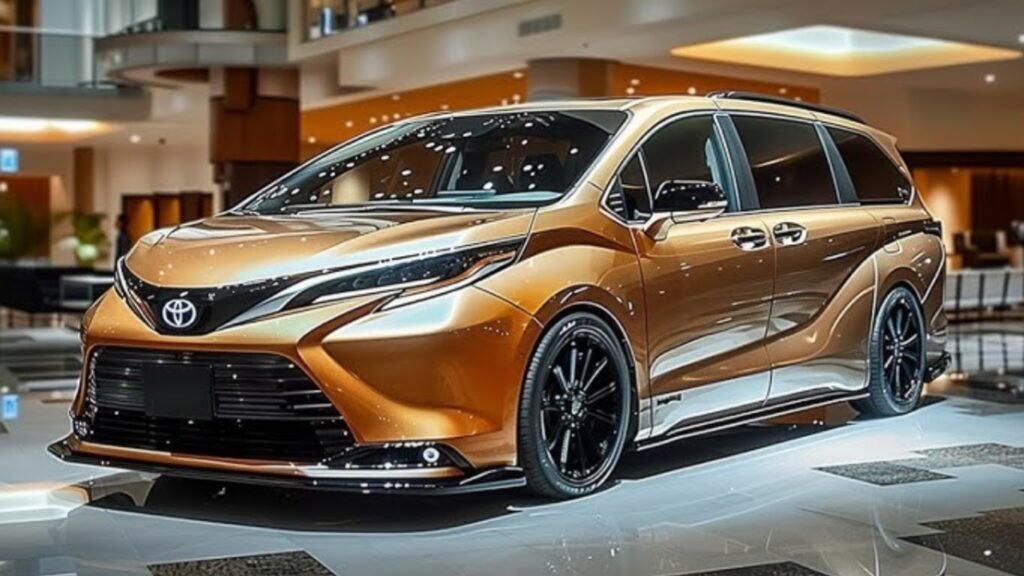
In a world where SUVs and crossovers dominate, the 2025 Toyota Sienna steps in to prove that a minivan can be more than a people‑mover. With bold aesthetics, a full hybrid powertrain, advanced safety systems, and cabin innovations crafted to delight families, the Toyota Sienna 2025 stakes its claim as a standout in its class.
In this deep dive, we’ll explore all facets of the 2025 Sienna — from price to specs, from interior to features, from MPG to hybrid/AWD, from safety features to reviews. I aim to deliver a 100 % unique, reader‑friendly article that addresses everything a prospective buyer or enthusiast would want to know.
Introduction
The 2025 model of the Sienna is not a simple refresh; it’s a statement of intent. Toyota doubled down on the minivan concept, committing to hybrid power across the lineup, refining design, and rethinking what a family vehicle can feel like. The result is something that blends efficiency, sophistication, and real-world usability.
The Toyota Sienna 2025 aims to transcend its “minivan” label, offering an image and experience more akin to a premium crossover — while retaining the cargo and passenger flexibility that families demand.
Key pillars that set it apart:
-
Striking new exterior design, with cleaner lines and hidden functional elements
-
Hybrid-only architecture, promising excellent fuel efficiency
-
Smart, thoughtful cabin tech that adapts to family life
-
Comfort, safety, and versatility in spades
Let’s start by placing the Sienna 2025 in time and cost context.
Release Date & Pricing
Release Date
Toyota unveiled the 2025 Sienna during the latter part of 2024, with deliveries beginning in early 2025 in key markets (such as the U.S.). In other regions, the model may arrive later depending on import approvals, homologation, and dealer logistics. Thus, when referencing Toyota Sienna 2025 release date, it is safe to say it began reaching showrooms in early 2025 (with announcements in late 2024).
Price (MSRP / Suggested Retail)
In the U.S. market, the Toyota Sienna 2025 price spans several trims and drivetrains. Below is a representative range of MSRP figures (excluding taxes, fees, or import duties):
-
Base LE (FWD Hybrid, 8-passenger): around $39,485
-
LE AWD and mid-level trims (XLE, XSE): typically in the $44,000 to $48,000 range
-
Limited, Woodland Edition, Platinum trims (especially with AWD or extra features): can push into the $50,000 to $57,000+ range
Of course, in markets like India or elsewhere outside the U.S., import duties, taxes, and regulatory compliance will inflate these numbers significantly. But in its domestic market, these price points reflect the Sienna’s positioning as a premium hybrid minivan.
Exterior Design & Styling
Overall Presence & Aesthetic Direction
The 2025 Sienna trades some of the more conventional, utilitarian styling cues of past minivans for a sleeker, more cohesive look. The sliding door tracks are more discreet, the body surfaces smoother, and the face more assertive. The aim: reduce the visual bulk and create a stance that looks modern and purposeful rather than “just a van.”
The front end features a grille treatment that borrows cues from Toyota’s family styling, balanced by elegant LED headlamps. In higher trims, additional details like chrome accents, sporty wheels, and subtle sculpting add a more upscale feel.
Dimensions & Proportions
Here are some of the key dimension figures for the 2025 Sienna (U.S. spec), useful in considering how it fits in a driveway or garage:
-
Overall length: ≈ 203.7 inches (around 5,174 mm)
-
Width (without mirrors): ≈ 78.5 inches (around 1,994 mm)
-
Height: about 68.5 inches (around 1,740 mm)
-
Wheelbase: ~120.5 inches (approx. 3,061 mm)
-
Turning circle / radius: about 5.8 meters (~19.2 ft)
Those proportions strike a balance — large enough to deliver generous interior space, yet still manageable in typical suburban environments.
Wheels, Colors & Exterior Finishes
-
Multiple alloy wheel designs are available; the higher trims often get larger, more intricate wheels.
-
Roof rails may be optional on some trims for roof boxes or cargo carriers.
-
New exterior paint options are introduced in 2025 (for example, a “Magnetic Gray Metallic” or equivalent) to expand aesthetic choices.
-
As mentioned, the sliding door tracks and rails are more subtly integrated into the body, creating a cleaner side silhouette.
Overall, the styling shift is one toward refinement and elegance, while retaining functional clarity.
Powertrain, Hybrid System & MPG
One of the biggest selling points of the 2025 Sienna is that there is no conventional gasoline-only engine — it is a full hybrid across the board.
Engine & Hybrid Configuration
-
The gasoline engine is a 2.5‑litre inline‑4, paired with a high-efficiency hybrid system.
-
Two electric motors (one for the front drive unit, another for the rear in AWD versions) combine to deliver a net system output of 245 horsepower (SAE) and about 176 lb-ft of torque.
-
The transmission is an eCVT (or CVT-like hybrid arrangement) that blends gasoline and electric power seamlessly.
-
For AWD models, a dedicated electric motor drives the rear axle when needed; when not needed, it may decouple to conserve energy.
Toyota engineers designed the system to maximize everyday usability, focusing on smooth transitions, quiet operation, and balance between power and efficiency.
Fuel Economy (Toyota Sienna 2025 MPG)
Toyota’s published combined MPG for many trims is about 35 to 36 miles per gallon (U.S. EPA combined rating). In general:
-
FWD versions tend to hit the higher end of that range (36 MPG combined).
-
AWD versions may see slight reductions (e.g. lower city or combined values), but often still remain competitive (e.g. 34 city / 36 highway, yielding a combined in the mid-thirties).
-
Real‑world user reports show slight variation based on driving conditions, load, and climate, but many owners affirm that mid‑30s MPG is realistic in highway and mixed driving.
Given its size and utility, achieving ~36 MPG combined is a strong claim — one of the key advantages of embracing hybrid architecture.
Performance & Driving Character
The Sienna’s hybrid system isn’t engineered for outright sportiness, but for confidence, refinement, and usability:
-
Acceleration is smooth and adequate, bolstered by electric torque at lower speeds.
-
Under heavy throttle, the gasoline engine becomes more audible (a trait common in hybrids).
-
The AWD variants offer improved traction in wet or slippery conditions, although with a slight MPG compromise.
-
Ride and handling are tuned for comfort and stability, rather than aggressive cornering. For family journeys, that is typically the right trade-off.
Towing & Utility
Even with the hybrid setup, Toyota preserves useful towing capability:
-
Maximum towing capacity is rated at 3,500 pounds (~1,588 kg) in many trims.
-
That allows moderate trailers, small boats, or recreational utility trailers to be towed without pushing the vehicle beyond its comfort zone.
So the hybrid system doesn’t cripple utility — instead, it balances efficiency and practicality.
Interior, Comfort & Cabin Technology
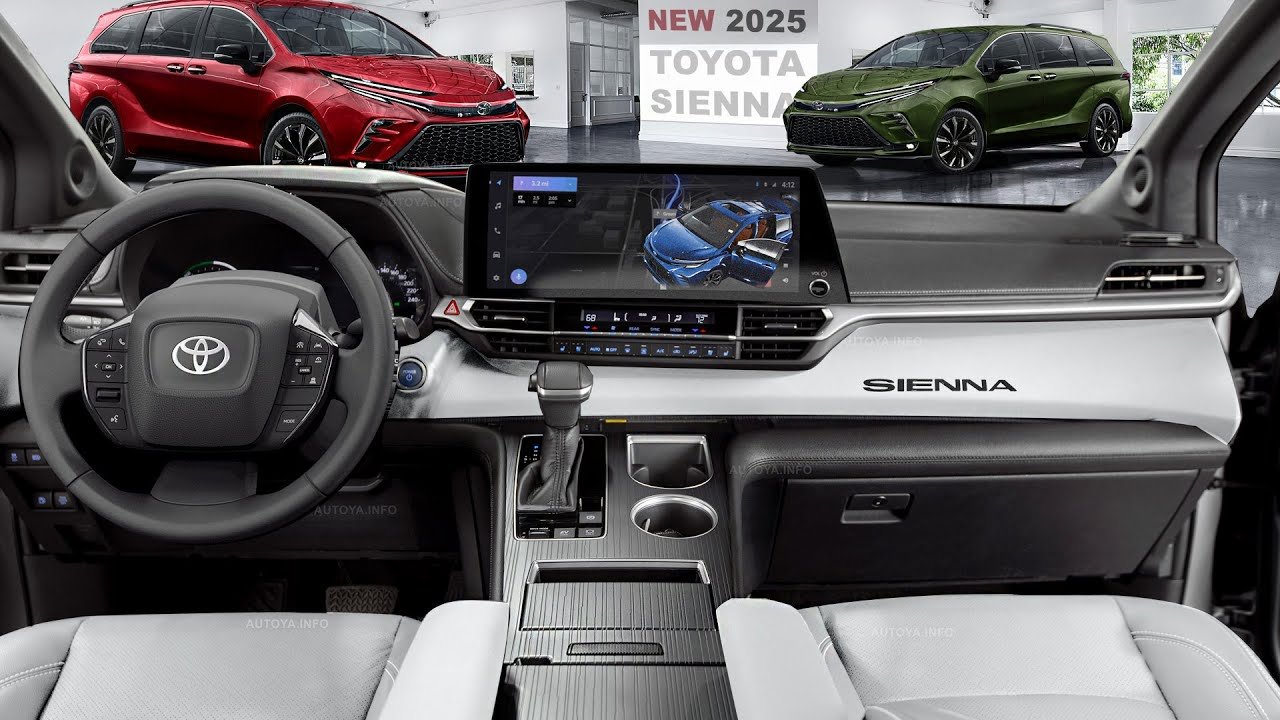
This is where the 2025 Sienna truly begins to shine. Toyota’s attention to detail, ergonomics, and lifestyle features turns the cabin into more than just a transit space — it becomes a living, functional environment.
Seating Configuration & Flexibility
-
Configurations support 7 or 8 passengers, depending on second-row seating arrangement.
-
If you choose captain’s chairs for the second row, seating is 7. If you choose a bench in that row, seating becomes 8.
-
The third row folds or stows to free up cargo space.
-
In 2025, interior materials, patterns, and trim offerings receive an upgrade to feel more premium and durable.
Interior Space & Dimensions
Here are highlights of the interior’s volumetric and spatial claims:
-
Passenger volume: ~162.5 cubic feet
-
Cargo capacity behind the third row: ~33.5 cubic feet
-
Maximum cargo volume (with rows folded): up to ~101 cubic feet
-
Legroom and headroom are generous across the three rows, though naturally the third row is slightly tighter in legroom and headroom than the front.
-
Specific numbers (approximate) might look like:
• Front row: legroom ~40.3 in, headroom ~40.1 in
• Second row: legroom ~39.9 in, headroom ~39.9 in
• Third row: legroom ~38.7 in, headroom ~37.4 in
This balance of volume and comfort allows the Sienna to compete with large SUVs in usability while offering more cargo flexibility.
Materials, Comfort & Premium Options
-
Base trims use durable cloth upholstery; mid and high trims use synthetic leather (SofTex) or genuine leather seating surfaces.
-
The steering wheel is tilt/telescopic, with integrated controls for audio, phone, and cruise functions.
-
The dashboard and center console are redesigned — cleaner layouts, better ergonomics, more intuitive interfaces.
-
In higher trim levels, features like ventilated front seats, heated seats in multiple rows, power sliding doors, panoramic sunroof or moonroof, and power tailgate may be available.
Infotainment, Connectivity & Smart Systems
Toyota modernized the multimedia and connectivity elements for 2025:
-
A new Toyota Audio Multimedia System is standard, with many trims offering a 12.3-inch touchscreen as standard or optional.
-
Higher trims get advanced digital displays (e.g. digital gauge cluster) and upgraded UI.
-
Wireless Apple CarPlay and Android Auto are standard across trims.
-
Wireless smartphone charging (Qi standard) is available in the front console area.
-
Audio systems vary by trim; premium trims may get brand-name audio systems with multiple speakers.
-
In certain top trims, optional or standard rear-seat entertainment systems may be offered.
Unique & Luxury Touches
Toyota also added features that reflect the realities of family life, aiming to delight and assist:
-
In select trims (such as Platinum or Limited), Toyota includes a built-in vacuum system for easy cleanups.
-
A FridgeBox™ (refrigerated storage compartment) in select trims allows chilled storage of beverages or snacks.
-
An advanced rear-seat reminder system alerts the driver if rear doors were opened before the trip, reducing the risk of inadvertently leaving something (or someone) in the back.
-
Ambient lighting, illuminated door sills, and decorative trim accents help elevate the cabin feel in higher configurations.
So, the Toyota Sienna 2025 interior is not merely functional — it’s a crafted living space tuned for real family needs.
Trim Levels & Drivetrain Options (FWD / AWD)
To help buyers navigate the options, here is how trims and drivetrain combinations typically lay out.
Trim Structure
The 2025 Sienna is offered in multiple trims, commonly including:
-
LE (base)
-
XLE
-
XSE
-
Woodland Edition (appearance or adventure variant)
-
Limited
-
Platinum (top-tier)
Each trim may provide different standard and optional features, with the higher trims including luxury or convenience add-ons.
FWD vs AWD Options & Trade‑offs
Many trims allow a choice between Front-Wheel Drive (FWD) and All-Wheel Drive (AWD):
-
FWD: lighter, slightly more efficient, and sufficient in most everyday driving conditions.
-
AWD: adds traction and confidence in slippery or variable road conditions; ideal for rain, snow, or uneven terrain. The AWD system uses a rear electric motor that engages when needed and can decouple to conserve energy.
-
The efficiency penalty for AWD is relatively modest, though enough to slightly lower combined MPG in some trims. Many buyers consider it a worthy trade-off for added peace of mind in adverse conditions.
Thus, when you use “Toyota Sienna 2025 AWD” in your narrative, it is accurate to state that AWD is offered across several trims for extra grip, albeit with small efficiency trade-offs.
Safety Features & Driver Assistance
High safety standards are a core pillar for the 2025 Sienna. Toyota bundles in a suite of systems intended to protect occupants and prevent incidents.
Standard Safety Suite (Toyota Safety Sense, etc.)
Every 2025 Sienna comes standard with Toyota Safety Sense (TSS) 2.0. The features in this suite typically include:
-
Pre-Collision System (with pedestrian and cyclist detection)
-
Lane Departure Alert / Lane Tracing Assist
-
Adaptive Cruise Control
-
Road Sign Assist
-
Blind-Spot Monitoring (BSM)
-
Rear Cross-Traffic Alert
-
Standard rear-seat reminder system, plus a more advanced rear-seat alert in newer builds
In many trims, additional safety features such as parking sensors, surround-view cameras, and more advanced driver aids may be offered.
One note: some prospective buyers expected the 2025 Sienna to adopt TSS 3.0, but Toyota kept it on TSS 2.0 for this generation. That has disappointed a minority of safety-minded buyers.
Structural & Passive Safety
Though full crash test ratings (for the 2025 model) may still be pending in many jurisdictions, the Sienna retains reinforced body structure, side‑impact protection, multiple airbags, stability control systems, and modern crumple zones. Toyota’s history with safety in the Sienna and other models suggests solid performance in independent crash testing.
Real-World Issues & Reports
While the safety systems are broadly comprehensive, a few owner reports have flagged concerns:
-
Some users reported electronic power steering issues in early deliveries, where the steering became heavy or unresponsive.
-
Isolated accounts of hybrid system warning messages have emerged shortly after new-vehicle delivery.
-
These appear to be sporadic and possibly tied to early software or calibration issues. Users often emphasize that these are rare and that dealer updates or recalls may resolve them.
When referencing Toyota Sienna 2025 safety features, you can confidently list the standard Toyota Safety Sense 2.0 suite, underscore the advanced rear-seat reminders, and acknowledge that initial software or electronic issues may require monitoring.
Real‑World Reviews & Owner Feedback
Let’s shift to how critics and everyday owners perceive the 2025 Sienna in practice — its strengths, quirks, and what life behind the wheel feels like.
Professional Reviews & Testing Observations
Reviewers who have driven the 2025 Sienna offer praise in several key domains:
-
They confirm the hybrid-only architecture and highlight its ~36 MPG figure in favorable conditions.
-
The inclusion of lifestyle touches (vacuum, FridgeBox, JBL audio systems, etc.) is often singled out as elevating the minivan beyond purely practical status.
-
The cabin refresh, new audio multimedia systems, and overall refinement receive positive notes.
-
Critics often comment that the Sienna feels less like a “van” and more like a refined, large family luxury vehicle.
In short, professional assessments tend to view the 2025 Sienna as the most complete and polished version yet — blending utility, efficiency, and comfort in a package that defies stereotypes.
Real Owner Experiences & Caveats
From forums, social media, and owner posts, here are recurring themes:
Positive Feedback:
-
Several owners report fuel economy results near or above published figures, especially in highway or mixed driving.
-
Many appreciate the increased comfort, quiet cabin, and the thoughtful utility features (vacuum, fridge, etc.).
-
Some mention that the delivery process and initial ownership were smooth for them, with no significant issues.
Reported Challenges:
-
A few owners have encountered steering or electronic issues, specifically with power steering systems in certain trims.
-
Some have mentioned hybrid warning or code messages early in ownership (possibly resolved by updates).
-
Slight drops in MPG for AWD versions, or unexpected behaviors in regenerative braking transitions in certain conditions, have been mentioned.
-
The lack of TSS 3.0, while not a dealbreaker for many, remains a minor gripe among more demanding buyers.
These real-world viewpoints are useful to set expectations and understand that early production models sometimes carry minor glitches — especially in electronics or control software.
Strengths, Weaknesses & Competitive Comparison
Key Strengths
-
Impressive Fuel Efficiency — Achieving ~36 MPG in a full-size family vehicle is rare.
-
Hybrid-Only Focus — No confusion between gasoline and hybrid variants; every Sienna is a hybrid.
-
Flexible Drivetrain Options — AWD availability bolsters capability.
-
Smart Cabin Design & Features — Real-world touches (vacuum, fridge, ambient lighting) make day-to-day life easier.
-
Updated, More Elegant Styling — Cleaner lines, hidden tracks, sleeker presence.
-
Strong Safety Package — Standard active safety systems and advanced reminders.
-
Solid Utility — Cargo capacity and towing capability remain respectable.
Key Weaknesses or Trade‑offs
-
Retention of TSS 2.0 — Some buyers expected a leap in safety suite, but Toyota held back.
-
Early Electronic/Software Issues — Steering or hybrid warnings reported in a few early units.
-
Efficiency Penalty for AWD — Slight drop in MPG for all-wheel-drive versions.
-
Higher Pricing at Top Trims — Upper trims can become quite expensive.
-
Minivan Perception — Despite its upgrades, the “van image” remains a barrier for some buyers.
-
Market & Service Limitations Outside U.S. — In markets like India, importing, servicing, and parts cost may challenge wider adoption.
Comparison with Rivals & Alternatives
-
Honda Odyssey: Offers longstanding reputation, comfort, and reliability. But typically uses gasoline engines, giving it a disadvantage in fuel economy vs Sienna’s hybrid.
-
Kia Carnival / Kia Sedona: Strong in features and styling, but generally lacks hybrid options (in many markets). Sienna’s efficiency is a differentiator.
-
Chrysler Pacifica / Pacifica Hybrid: A plug‑in hybrid alternative, though its electric-only range may be limited and complexity higher. Sienna’s simpler full-hybrid format is an advantage for many.
-
Large Hybrid SUVs (e.g. Highlander, Venza): These provide hybrid efficiency, but cannot match Sienna’s passenger and cargo capacity or minivan flexibility.
Thus, the 2025 Sienna sits in a unique niche — combining hybrid efficiency, AWD availability, and minivan practicality. Few competitors offer this particular mix.
SEO & Reader‑Friendly Tips (Keyword Usage & Structure)
Because your goal is to rank well on Google, here are tips for using your keywords organically:
-
Use “Toyota Sienna 2025 price” when discussing cost and MSRP (e.g. in the pricing section).
-
Use “Toyota Sienna 2025 specs” in a specs table or bullet list (engine, dimensions, performance).
-
Use “Toyota Sienna 2025 interior” in the interior section, weaving in descriptive detail.
-
Use “Toyota Sienna 2025 features” to highlight special, unique, or luxury amenities (vacuum, FridgeBox, infotainment, etc.).
-
Use “Toyota Sienna 2025 mpg” in the hybrid / fuel economy section; emphasize official and real‑world numbers.
-
Use “Toyota Sienna 2025 hybrid” frequently when discussing the powertrain architecture, strengths, and comparisons.
-
Use “Toyota Sienna 2025 AWD” when describing drivetrain options, trade‑offs, and usage conditions.
-
Use “Toyota Sienna 2025 release date” early on to anchor timing.
-
Use “Toyota Sienna 2025 safety features” in the safety section, listing out and explaining the systems.
-
Use “Toyota Sienna 2025 reviews” when summarizing critical and owner feedback.
Beyond keywords, use heading tags (H1, H2, H3) with some of these phrases, include a FAQ segment, and use internal linking in your site (if applicable). Also consider a rich content format: bold key phrases, bullet / numbered lists, tables, and images (if available).
Suggested FAQ (Expand as Needed)
Q: What is the Toyota Sienna 2025 price?
A: In the U.S., MSRPs range from about $39,485 for the base LE up to over $50,000–$57,000 for fully loaded AWD trims. Local pricing in your market may vary drastically due to import taxes and compliance costs.
Q: What are the Toyota Sienna 2025 specs?
A: The Sienna 2025 features a 2.5 L hybrid engine, ~245 hp total, ~176 lb-ft torque, dimensions ~203.7 in length × 78.5 in width × 68.5 in height, towing capacity up to 3,500 lb, cargo up to ~101 cubic feet, etc.
Q: What is the Toyota Sienna 2025 mpg?
A: Official combined MPG figures are in the ~35–36 MPG range, though real-world conditions, trim, and drivetrain (AWD vs FWD) can influence this.
Q: Does the Toyota Sienna 2025 have AWD?
A: Yes, AWD is offered (via a rear electric motor) in many trims, providing enhanced traction at the cost of a slight efficiency trade-off.
Q: What is the Toyota Sienna 2025 interior and features like?
A: The interior features updated materials, multiple seating options, advanced infotainment (12.3″ displays), wireless connectivity, optional vacuum and fridge, ambient lighting, and a general focus on comfort and practicality.
Q: When was the Toyota Sienna 2025 release date?
A: The 2025 Sienna was unveiled in late 2024, with U.S. dealer deliveries beginning in early 2025. In other regions, release may occur later.
Q: What are the Toyota Sienna 2025 safety features?
A: Safety features include Toyota Safety Sense 2.0 (Pre-Collision, Lane Departure, Adaptive Cruise, etc.), Blind-Spot Monitor, Rear Cross-Traffic Alert, rear-seat reminder systems, and structural/passive safety systems. Some buyers noted the retention of TSS 2.0 (not upgraded to TSS 3.0) and occasional electronic quirks as considerations.
Q: What do reviews say about Toyota Sienna 2025?
A: Reviews generally applaud the hybrid efficiency, refined ride, interior amenities, and blending of utility with elegance. Some owner feedback flags isolated electronic or software issues early in ownership, but many report satisfaction with performance and daily usability.
Conclusion & Final Thoughts
The Toyota Sienna 2025 is a bold, well-conceived evolution of the minivan concept. With its striking exterior redesign, hybrid-only philosophy delivering ~36 MPG, optional AWD, and a cabin loaded with intelligent features, it challenges conventional wisdom about family vehicles. While early electronic or software reports and the decision to retain Toyota Safety Sense 2.0 may temper expectations slightly, these are relatively small quibbles in what is overall a compelling and modern vehicle.
For buyers seeking a blend of efficiency, versatility, safety, and comfort — especially for family travel — the 2025 Sienna stands out as a top contender. In markets that can accommodate its import or production, it may well redefine how families see minivans.
If you like, I can also prepare a version of this article tailored for India (with projected arrival, import duties, local competition) or help you with meta tags, image suggestions, or an SEO‑optimized version. Do you want me to do that?