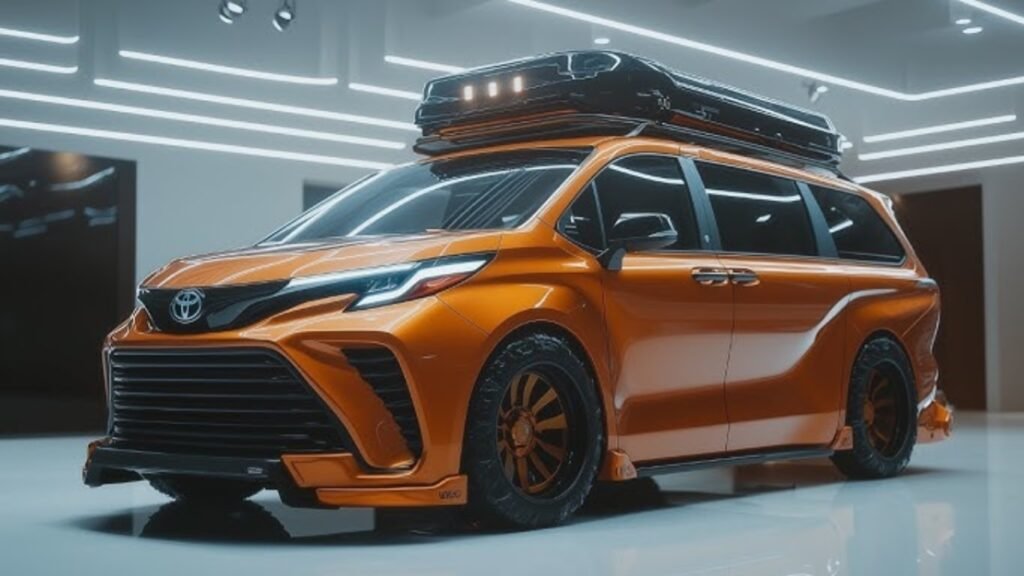
In 2025, Toyota continues to push boundaries with its minivan flagship. The Toyota Sienna 2025 emerges not just as a people mover, but as a refined, efficient, high-tech lounge on wheels. With hybrid efficiency, bold design, and thoughtful touches throughout, this model is intended to elevate everyday driving into something special.
From city commutes to long highway journeys, the 2025 Sienna aims to blend practicality, comfort, and luxury. In this deep dive, we explore every dimension—mechanical, aesthetic, experiential—so you (or your readers) can fully understand what the 2025 Toyota Sienna offers. Let’s open the door to its story.
1. Release & Model Year Context (Toyota Sienna 2025 Release Date)
Before exploring all the bells and whistles, it’s useful to understand where the 2025 Sienna fits in Toyota’s roadmap.
The current generation of Sienna began in 2021, and the 2025 model is not a full redesign but a refresh. Key updates include revised interior materials, upgraded tech, and enhanced convenience features. The release for the 2025 model has already occurred: dealerships list and deliver 2025 models now, and review publications already test them.
Thus, the 2025 Toyota Sienna is a mid-cycle refresh—refining, not reinventing. Its purpose is to stay timely, competitive, and appealing without overhauling the entire platform.
2. Powertrain, Efficiency & AWD Option (Toyota Sienna 2025 Hybrid + AWD)
A standout feature is that the 2025 Sienna remains a hybrid-only lineup. Toyota has doubled down: no gasoline‑only variants, no plug‑in options (for now)—just a hybrid system.
2.1 Hybrid Architecture & AWD Variant
Under the skin, the Toyota Sienna 2025 hybrid system pairs a 2.5‑liter four‑cylinder gasoline engine with electric motors. The total combined power output is 245 horsepower. This is achieved via a front electric motor and, in the AWD variant, an additional rear motor that powers the rear wheels when needed (on demand).
Thus, the system offers flexibility: front‑wheel drive for those prioritizing maximum efficiency, and toyota sienna 2025 awd for those needing extra traction in inclement conditions.
Adding AWD does not change the horsepower figure; the rear motor is supplemental and designed to engage only when necessary.
2.2 Fuel Economy & “36 MPG Hybrid Efficiency”
One of the most compelling specs of the 2025 Sienna is its claimed fuel economy. The marketing tagline “36 MPG hybrid efficiency” is based on the front‑wheel drive model under favorable conditions (city/highway mix). In official estimates, the FWD model achieves about 36 mpg combined (with similar city and highway values).
In the AWD variant, there is a modest efficiency penalty. The AWD Sienna typically is rated at 35 mpg combined, with slight reductions in city driving due to the additional rear motor and associated mechanical overhead.
In real-world tests and usage, fuel economy will vary due to load, climate, driving style, terrain, and accessory use. Some long‑term tests of AWD models report averages closer to mid‑20s mpg when driven aggressively or in cold climates; on highway stretches, 33 mpg or more is possible in favorable conditions.
But the headline remains: for a minivan with AWD potential and full hybrid architecture, delivering ~36 mpg in the FWD variant is an impressive engineering achievement.
3. Exterior Design & Styling (Bold, Sleek, Modern)
While the mechanical side is critical, the way the 2025 Sienna looks is also meant to shift perceptions—from boxy family van to purposeful, expressive vehicle.
3.1 Front Fascia & Signature Identity
Toyota has given the 2025 Sienna a more aggressive front end: a large grille with intricate textures, slimmer LED headlights, and sharper creases. These design cues aim to lend the vehicle a presence rather than blending into the background.
The sliding door tracks are more subtly integrated, giving cleaner side surfaces. Crisp character lines run along the length of the vehicle, hinting at motion even while stationary.
3.2 Proportions, Dimensions & Cargo
In terms of size, the 2025 Sienna remains broadly similar to prior generation—long, wide, but not overly tall. Its footprint gives it room and presence, yet Toyota worked to keep its height and overhangs in check so it doesn’t feel unwieldy.
Key dimensional numbers (varying slightly by trim) include a length over 200 inches and a width close to 78‑79 inches. Curb weights vary by trim and drivetrain (AWD versions being heavier).
Cargo capacity behind the third row is good, though not class‑leading, and Toyota misses some flexibility because the second‑row seats are not removable. Maximum cargo when all rear seats are folded or stowed is still generous, though less versatile than some rivals.
Toyota also retains a towing capability (on certain trims) of around 3,500 lbs, allowing light towing of trailers or small boats.
Overall, the design balances presence, practicality, and style.
4. Interior & Cabin Experience (Toyota Sienna 2025 Interior)
If the exterior invites you in, the interior aims to reward you. The 2025 Sienna’s cabin is a major battleground for comfort, usability, and technology.
4.1 Seating Layout & Comfort
You will find configurations for 7 or 8 passengers depending on the trim. The high trims use captain’s chairs in the second row (7‑seat layout), while lower trims may retain a bench (8 seats). The seats themselves are intended to be comfortable, supportive, and adjustable—with more upscale upholstery and materials in higher trims (leather or synthetic leathers, two‑tone stitching, etc.).
Legroom, headroom, and shoulder room in rows one and two are competitive. The third-row is usable for most adults for moderate durations, though they will notice less space than in the first two rows.
One limitation, however, is that the second-row seats do not remove. They slide and pivot, but cannot be fully taken out. This reduces flexibility when you need to haul large cargo. Some rivals allow full removal, which is an advantage in versatility.
4.2 Dashboard, Tech & Infotainment
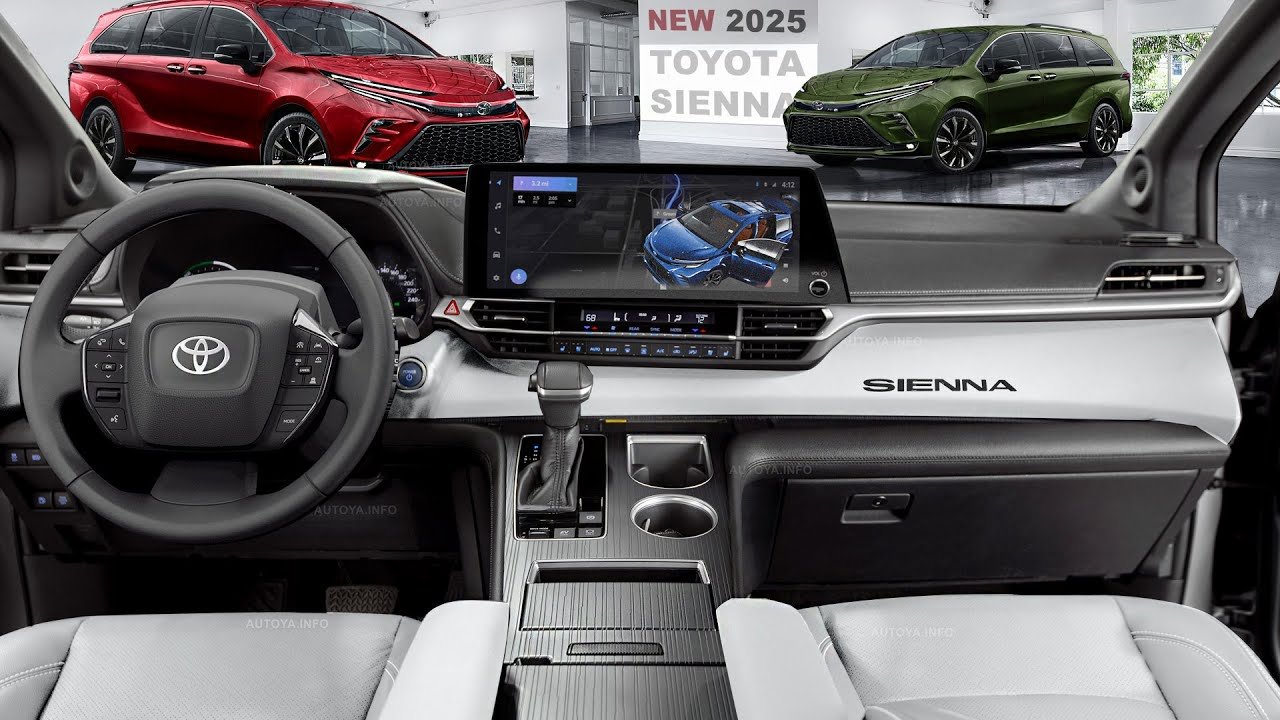
2025 sees a refresh in the multimedia and instrumentation areas. Most trims adopt a 12.3‑inch touchscreen for infotainment, while the base trim may use a smaller 8‑inch screen. Wireless Apple CarPlay and Android Auto are standard. The system also includes improved wireless charging and USB‑C ports.
Higher trims may include a digital gauge cluster (12.3 inches) and more customizable display layouts. Toyota’s software interface is modernized, though in some reviews the system still leaves room for improvement in layout and intuitiveness.
Toyota also adds the Advanced Rear Seat Reminder, a radar‑based system that senses when someone (child or pet) is left in the rear after the driver exits, and can trigger alerts to prevent leaving someone behind.
As a luxury touch, upper trims offer a built-in vacuum (often concealed in the console) and a refrigerator / FridgeBox™ unit, ideal for family trips or keeping drinks cool. These are optional in mid trims and standard in the top Platinum trim.
Other interior features include ambient lighting, heated and ventilated front seats (on higher trims), heated steering wheel, plenty of storage cubbies, and quality finishes on surfaces.
4.3 Practicality, Tradeoffs & User Notes
-
The second-row non-removable seats limit cargo flexibility.
-
Access to the third row is decent for its class, but one might find height and maneuvering constraints in tight spaces.
-
Some owners note that rearward heating / cooling may be less strong than desired, especially in extreme climates.
-
Spare tire presence is inconsistent; some owners report their 2025 Siennas lacking a spare, or being offered a spare as an expensive optional add-on.
-
Build quality and fit & finish seem to have improved slightly in 2025 compared to prior years, according to some user impressions.
5. Driving Dynamics & Performance
While the Sienna is not intended to be a sports van, Toyota has tuned it to feel composed, comfortable, and confidence-inspiring in everyday scenarios.
5.1 Acceleration & Power Delivery
In testing, an AWD Sienna Limited achieved 0‑60 mph in around 7.5 seconds under favorable conditions. That’s solid for a large vehicle with a hybrid drivetrain. Under more typical or loaded conditions the acceleration feels moderate. When pushed hard, the gasoline engine can become audible and somewhat droning.
In everyday driving, the electric motors provide torque for smooth off-the-line acceleration and assist in passing and merging. The system is calibrated for refinement over aggressive response.
5.2 Handling, Steering & Ride
The ride quality is a strength: the suspension soaks up road imperfections well, and the overall chassis control is stable. Steering is light and easy, though some critics find it lacks feedback or precision, especially in expressive driving. In snow or low-traction conditions, the AWD system helps grip, but the Sienna is no sports car—its focus is comfort, composure, and predictability.
Braking distances are acceptable for its class, though in some tests and user reviews the feeling of the brakes is described as uneven—requiring some adaptation by drivers to achieve smooth stops.
The turning radius and maneuverability are designed to be reasonable for such a large vehicle, making parking and tight turns manageable, especially with parking assist features and cameras.
5.3 Real‑World Efficiency & Behavior
Efficiency is at its core. In mixed driving, many users report MPG results lower than the ideal 36 mpg, especially in cold weather, hilly terrain, or with full loads. On highway runs, however, the Sienna can deliver solid mpg numbers—30s in favorable conditions for the AWD model.
Long-term tests of AWD models show averages around the upper 20s mpg if driving aggressively or under mixed conditions. Over long highway stretches, 33–34 mpg is possible. The hybrid system shines especially in stop-and-go traffic or city driving, where electric assistance and regenerative braking can reduce fuel use significantly.
6. Safety & Driver Assistance (Toyota Sienna 2025 Safety Features)
Given the family-oriented role of a minivan, safety systems in the 2025 Sienna are extensive and carefully engineered.
6.1 Active Safety & Driver Assist
All 2025 Sienna models come with Toyota Safety Sense 2.0 (or a variation thereof), which includes:
-
Forward collision warning + automatic emergency braking (with pedestrian detection)
-
Lane departure alert + lane keeping assist
-
Adaptive cruise control
-
Automatic high beams
Additional features such as blind-spot monitoring, rear cross-traffic alert, parking sensors, and 360‑degree surround cameras are available in higher trims or as options.
The Advanced Rear Seat Reminder is noteworthy: it uses millimeter-wave radar to detect motion or presence in the rear and issues alerts (audible, flash, or even via smartphone notification) to prevent leaving passengers behind.
6.2 Structural Safety & Ratings
The 2025 Sienna leverages a reinforced body and multiple airbags (front, side, curtain) to provide passive protection. In safety assessments, the Sienna is expected to continue high performance:
-
In prior model years, the Sienna has achieved top safety ratings in NHTSA crash tests.
-
It has been named a Top Safety Pick in IIHS evaluations.
-
MotorTrend notes a five‑star overall NHTSA rating for 2025.
-
Critics expect the Sienna to maintain strong crash test credentials thanks to its structure and safety systems.
In sum, the Toyota Sienna 2025 safety features combine active and passive systems to deliver robust protection for families.
7. Trim Levels, Pricing & Value (Toyota Sienna 2025 Price)
Understanding what each trim gives you, and how much it costs, is essential in comparing to rivals.
7.1 Trim Breakdown & MSRPs
The 2025 lineup offers multiple trims, each escalating in features and price:
-
LE (base) — The entry point, still offering hybrid powertrain, essential comforts, and safety systems.
-
XLE — Adds more comfort, tech, and optional items.
-
XSE — A sportier aesthetic, additional styling cues and enhancements.
-
Limited — More luxury: better upholstery, more features such as vacuum/fridge option, more driver assists.
-
Woodland Edition — More rugged styling, slight off-road flair.
-
Platinum (top trim) — Fully loaded: premium materials, all features (vacuum, fridge, top infotainment, etc.).
In the U.S. market, Toyota Sienna 2025 price ranges (MSRP) approximately from $40,600 for the base models up to $58,300+ for the fully loaded Platinum versions. These prices depend on drivetrain (AWD adds cost), options, destination, and local factors.
Trim by trim, increments may include:
-
LE: base price
-
XLE: a mid-level step up
-
XSE: adds sport touches
-
Limited: more creature comforts
-
Platinum: fully loaded, premium pricing
The pricing puts the Sienna at the higher end of the minivan segment, but Toyota aims to justify that premium with efficiency, feature richness, and brand strength.
7.2 Ownership & Value Considerations
-
Toyota typically includes a two‑year complimentary maintenance program in many markets, which adds ownership value.
-
Warranties include a 3-year / 36,000-mile basic warranty, 5-year / 60,000-mile powertrain, and extended hybrid component cover (10 years / 150,000 miles) in many locales.
-
Resale value and reliability track record are strong suits for Toyota, helping offset higher acquisition cost.
-
Option cost for AWD, vacuum/fridge, premium trims, and advanced features will eat into value, so buyers should choose trims wisely relative to use case.
8. Specifications at a Glance (Toyota Sienna 2025 Specs)
Here is a consolidated specs snapshot for the 2025 Sienna:
-
Engine: 2.5‑liter inline‑4 gasoline + electric motors
-
Combined output: 245 hp
-
Drive options: FWD (standard) or AWD (optional via rear electric motor)
-
Transmission: eCVT (electronically controlled continuously variable)
-
Combined mpg (FWD): ~36 mpg
-
Combined mpg (AWD): ~35 mpg (with slight city penalty)
-
Length: ~203.7 inches
-
Width: ~78.5 inches
-
Height: Varies across trims, around 68.5–69.7 inches
-
Curb weight: ~4,600–4,700 lb (depending on trim)
-
Cargo (behind 3rd row): ~33.5 cu ft
-
Cargo (behind 2nd row): ~75 cu ft
-
Maximum cargo: ~100+ cu ft (depending on trim)
-
Towing capacity: up to 3,500 lbs (on appropriate trims)
-
Seating: 7 or 8 passengers
-
Safety: Toyota Safety Sense 2.0 suite, Advanced Rear Seat Reminder, etc.
-
Infotainment: 8‑inch (base) or 12.3‑inch screen, digital cluster on higher trims
-
Extra features: built-in vacuum, refrigerator, ambient lighting, wireless charging, heated/cooled seats
-
Warranty: 3 years / 36,000 miles basic; 5 years / 60,000 miles powertrain; hybrid battery support up to 10 years / 150,000 miles (depending on market)
These Toyota Sienna 2025 specs reflect the balance Toyota struck: generous dimensions and features, but mindful of weight and efficiency.
9. Reviews & Reception (Toyota Sienna 2025 Reviews)
How does the 2025 Sienna fare in real reviews and user feedback? Let’s see the praise, the criticisms, and what prospective owners should know.
9.1 Critical Praise
Many reviews and expert opinions highlight:
-
Exceptional fuel efficiency among minivans, especially in the FWD model
-
The rarity and appeal of a hybrid minivan with AWD availability
-
Comfortable ride, refined cabin, and generous features
-
Strong safety suite and new convenience add-ons
-
Toyota’s reputation for reliability and low depreciation
For instance, Car & Driver named it an “Editor’s Choice,” praising its efficiency and comfort while noting its modest performance.
Autoblog testers noted that even with AWD, the Sienna can reach an average of ~34 mpg in combined driving, a figure notable for its size and complexity.
In side-by-side comparisons to hybrid rivals, the Sienna often leads on fuel economy, though not always in cargo flexibility or outright power.
9.2 Common Critiques & Trade-Offs
Despite strong positives, the 2025 Sienna is not without compromises:
-
Performance under load
Some users find it underpowered or sluggish, particularly when fully loaded or overtaking at high speeds. Acceleration gains are modest and engine noise under hard throttle is noticeable. -
Cargo flexibility limitations
The inability to remove second-row seats is a frequently cited drawback, reducing adaptability for large cargo. -
Brake feel & stopping smoothness
Several reviews mention that the brakes feel uneven or require adjustment in driving style to get smooth stops. -
Real-world MPG variance
Many owners report mpg numbers significantly lower than the advertised 36, especially in cold weather or with heavy loads. Some highway runs yield mid-20s to low-30s mpg. -
Steering feedback & visibility issues
A number of user reviews mention that steering feels light, vague, or lacking in feedback. Some users also comment on mirror distortion or difficulty with visibility. -
Spare tire omission
Several owners note that their Sienna lacks a spare tire as standard; adding one post‑fact is possible but expensive. -
Reliability concerns in early units
Some early purchasers report minor malfunctions (e.g. hybrid error warnings) that required dealer attention—though these are not widespread and may reflect early build issues or particular component tolerances.
Real-world users on forums often express mixed views: many are thrilled by the efficiency and features, but some are frustrated by compromises. These voices are valuable for potential buyers to weigh.
10. Comparative Positioning & Competitive Edge
Where does the 2025 Sienna stand in a competitive minivan / large family vehicle landscape?
10.1 Strengths vs Rivals
-
Few vehicles offer a true hybrid minivan with the option of AWD—this gives the Sienna a distinctive niche.
-
Its fuel economy is among the best in class, especially for AWD-equipped models.
-
Toyota’s brand, reliability track record, resale value, and service network are strong selling points.
-
The inclusion of premium features like vacuum and refrigerator helps elevate it beyond purely utilitarian vans.
10.2 Areas Rivals May Outshine It
-
Some rivals allow fully removable seats or more flexible cargo strategies.
-
Gasoline-powered competitors may offer stronger outright performance (faster 0‑60, more torque) under load.
-
In extreme climates or heavy usage, hybrid gains diminish, making conventional vans more viable.
-
Price premium: top trims of the Sienna come with a high sticker, which may discourage cost-conscious buyers.
In many comparisons, the Sienna’s inefficiencies are offset by its unique combination of hybrid, AWD, and features—but only when the buyer values those attributes.
11. Summary & Outlook
The 2025 Toyota Sienna emerges as a compelling offering in the world of family mobility. With its hybrid-only architecture, available AWD, refined comfort, and modern tech, it delivers a balanced package that bridges efficiency and luxury.
Its headline “36 MPG hybrid efficiency” is achievable under ideal conditions in the FWD model, though real-world numbers will vary. The toyota sienna 2025 awd variant sacrifices a small amount of efficiency for better traction. The interior is comfortable and feature-rich, though second-row seat non-removability and some ergonomics are compromises.
In reviews, it garners praise for efficiency, comfort, and utility, while criticisms focus on performance under stress, brake feel, and cargo flexibility. Pricing is premium, but Toyota seeks to justify it via features, brand strength, and ownership value.
If I were advising a buyer: if your priority is comfortable, efficient, and technologically current family transport with occasional all-weather capability, the 2025 Sienna is among the best in class. If your emphasis is on cargo flexibility, sporty driving, or maximum performance, you should compare side-by-side with alternatives (some hybrid, some conventional) to see trade-offs.
Pingback: Toyota Sienna 2025: Turning Everyday Drives into Extraordinary Memories – Where Technology Meets Family Comfort